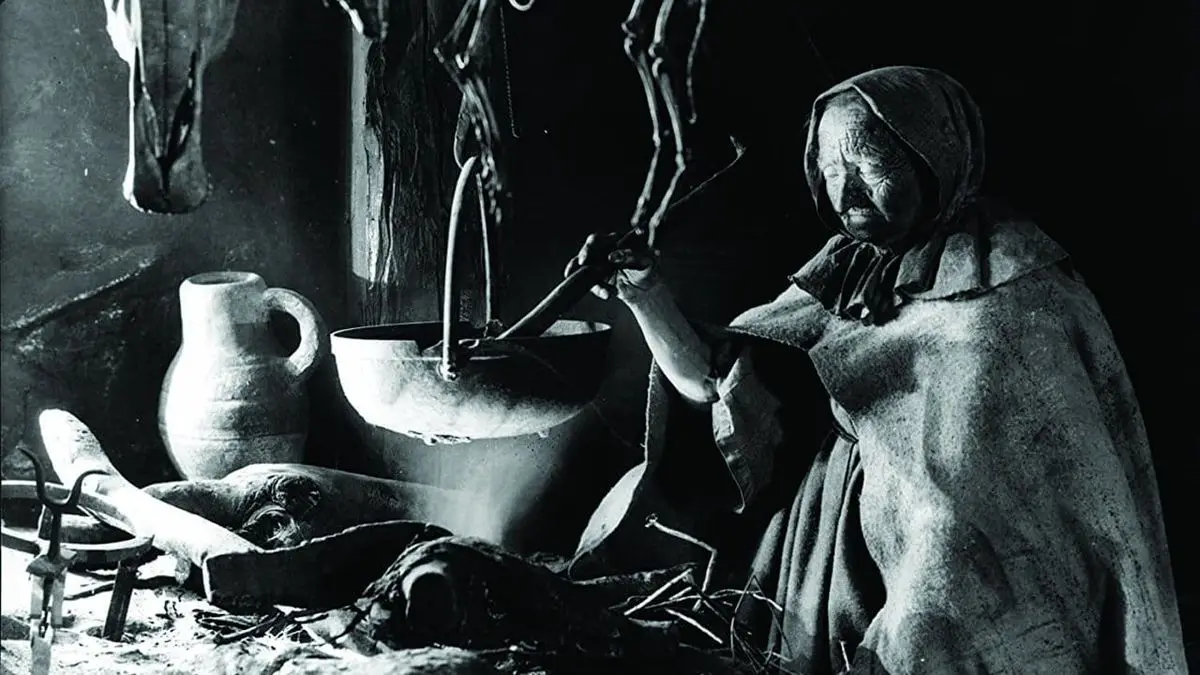
Häxan (1922)
I’ve used Häxan as my go to Halloween party vibes movie for years, and it turns out it’s a proto-documentary lecture.
A seven-part lecture, actually, on the history of witches, delivered by the Danish director Benjamin Christensen in 1922 with woodcuts, paintings and a model of hell. I’d never sat down with it properly until last night at the Parkway Theater, on 35mm with a live band, right after I saw the 4K re-release of Ken Russell’s The Devils. I didn’t plan the double feature, but it was a great one. Häxan is basically a proto-documentary, and it’s always so fun watching early filmmakers figure out how to structure a story before the rules set.
Häxan wants to be on the side of the women it’s about, and for six chapters it is. The men are the problem here: inquisitors, torturers, monks, a church that runs on accusations. The women are the victims, and the film is clear about that.
The one that got me was Maria the Weaver, the old, poor woman. Christensen shoots her in tight close-ups, her face crumpling and crying while the inquisitors work on her, and it reminded me so much of The Passion of Joan of Arc, which his fellow Dane Carl Dreyer wouldn’t make for another six years. Maren Pedersen is such an expressive, wonderful face to look at. I really felt for her.
Then the last chapter happens. Christensen sets Sister Cecilia, a possessed nun, beside a few modern cases, a sleepwalker, a shoplifter, and then gives his big reveal: the witches were hysterics all along. It’s so funny in retrospect. Hysteria is a diagnosis medicine threw out in 1980, one men made up to explain women they didn’t understand, and the film hands its witches from the inquisitor straight to the doctor while thinking it’s rescuing them. It’s one more male institution trying to control women’s bodies, from a film that’s trying hard to be on their side.
Seeing it so soon after The Devils made the difference obvious. Some sections of Häxan feel like they’re speaking directly to the plot of Russell’s film, but Russell’s nuns are in on their own possession. It saves their lives, and it’s a pressure release valve for all the repression they’re expected to perform as women in a convent. Häxan’s women only get to want things in a dream or in a confession pulled out by torture. Otherwise they’re old, homeless, mentally ill, disfigured, or just wrongly accused, and things only ever get done to them.
I’ve been noodling on how culture keeps looking back at itself, the way the 1970s kept looking back at the 1930s. In the 1920s something was in the water too: a new age of enlightenment looking back at a darker one and feeling sure it understood it. The Devils looks back at possessed nuns fifty years later, and Russell blames the church and the state instead of the nuns’ nerves.
This movie kind of rocked. If you want a pretentious Halloween watch, or you’ve been getting into The Devils lately, go find it.
Also on Letterboxd
Works on My Machine
Get the next post by email. My newsletter covers homelab builds, AI tools and open source, and it goes out when I have something to say.
It's free, and you can unsubscribe anytime. You'll get an email to confirm first.
If you liked this review, consider sharing it on Hacker News, Bluesky, LinkedIn, or X.
Joe
Karlsson
I write about my homelab, AI tools, databases, and the weird stuff I build on the side.
More about me →