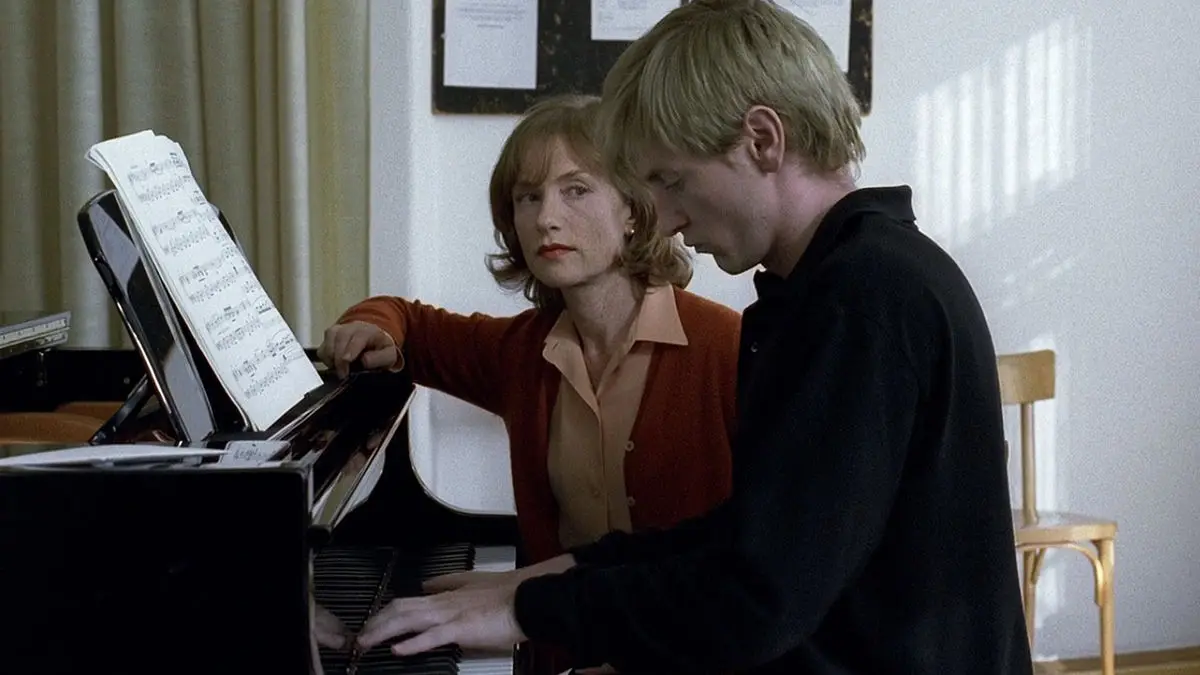
The Piano Teacher (2001)
The Piano Teacher is Michael Haneke’s cruelest film and, improbably, his most tender, a study of repression so complete that it curdles into self-destruction.
I had heard about this one for years, and I came to it braced for the version everyone warns you about: the clinical Haneke provocation, the endurance test, the icy Austrian dissection of a woman coming apart. What I did not expect was to be this moved. I spent the whole film with my heart breaking for Erika Kohut, and it kept breaking, right through an ending that left me shell-shocked. The sadness of it snuck up on me. This is one of the great screen tragedies, and almost nobody warns you about that part.
Haneke did not write this one and did not initially plan to direct it. He took on Elfriede Jelinek’s 1983 novel almost by accident, and it became his critical breakthrough, sweeping the top prizes at Cannes in 2001. What he found in the material, and in Isabelle Huppert, was the ideal vessel for his lifelong subject: the violence that hides inside bourgeois order, waiting.
Erika teaches piano at the Vienna Conservatory, and she is very good at it, which is exactly the trap. Her mother, played with monstrous need by Annie Girardot, groomed her from childhood into a performing instrument, a prodigy meant to justify a life, and the two of them now share an apartment and a bed in a codependence long since calcified into something like a marriage. Everywhere the film looks, it finds the same machinery: mothers hardening daughters, the conservatory hardening students, a whole genteel world that treats a woman as a device for producing beautiful sound and could not care less about the person operating it. It made her, to my eye, a kind of trained monkey in a Viennese cage, surrounded by phonies who love the music and not the musician.
That is the part that reached me, and I did not expect it to. Erika’s repression was not a temperament or a choice. It was installed. Her mother pressed it into her young, the way pressure turns coal into something hard and cold and valuable and unable to bend. I am at a point in my own life where I am only beginning to understand that what gets done to us that early does not stay behind us. It waits. It surfaces years later in shapes I do not recognize as mine until I am already standing inside them, working backward to figure out where they came from. Watching Erika is watching the far end of a reckoning that never arrived, a woman still being run, in middle age, by a childhood she was never once allowed to set down. I have rarely seen a film state the cost of that so plainly.
Because the pleasure never actually died in her. It only went underground and came back deformed. Her desire leaks out sideways, in voyeurism and cruelty and private harm, and Haneke will not let us look away or feel superior. She is capable of genuine evil, the broken glass slipped into a rival student’s coat is unforgivable, and she is also the most wounded person on screen. Domineering and submissive, victim and aggressor, she holds all of it at once. Watching her reach for intimacy is like watching someone try to wield a tool they were never permitted to learn, gripping when they mean to hold.
Huppert’s performance is the whole film. It is an iceberg, nearly all of it below the waterline, steely and still, and then something fractures and you feel the heat of everything she has buried come pouring through her eyes. When Walter Klemmer, a handsome young student played by Benoît Magimel, sets out to have her, she finally hands another person the truth of what she wants, and the horror of the film is how completely he fails to meet it. He wanted the fantasy of conquering a powerful woman. Faced with the real, damaged specificity of her needs, he turns into a monster, just another predator in a nicer coat. There may have been a version of this where Erika got the thing she needed. She simply never had the language or the safety to find it.
I will not spoil the last stretch except to say Haneke makes you sit in it, uncut and unrelieved, and that the final minutes are visceral and brutal in a way I felt in my body. What haunts me is the moment just before, when Erika stands battered in the concert-hall lobby and not one person asks if she is all right. They only expect her to walk in and perform. That is her entire life in a single shot. The cage was never locked from the inside.
It reminded me of Female Perversions and of Black Swan, other films about women unmade by the demand to be flawless in performance, though Haneke is colder and more merciless than either. But those are comparisons. The thing itself is the ache it left in me, the recognition that a hurt planted young can run a whole life if no one ever helps you dig it out. Erika is the warning. I am still sitting with her.
Also on Letterboxd
Works on My Machine
Get the next post by email. My newsletter covers homelab builds, AI tools and open source, and it goes out when I have something to say.
It's free, and you can unsubscribe anytime. You'll get an email to confirm first.
If you liked this review, consider sharing it on Hacker News, Bluesky, LinkedIn, or X.
Joe
Karlsson
I write about my homelab, AI tools, databases, and the weird stuff I build on the side.
More about me →