I ran 3,711 movie scripts through the Bechdel test. Fans’ favorite movies fail it. Critics’ don’t.

Blog Bechdel test results for 3,711 movie scripts: the films IMDb fans rate highest fail more often, and critics’ favorites don’t. By genre, decade and director.
TL;DR Of 3,711 movie scripts I checked in November 2026, the films fans rate highest fail the Bechdel test (two women, talking to each other, about something other than a man) more often than the films fans rate lowest. Critics’ favorites don’t. Part of it is genre: the fan canon leans on war and crime films from the 1970s to the 2000s. Part of it is how fans rate: on the same films, the ones fans like more than critics do pass least. Films directed by women pass far more often, but there are too few to move the list. The gap between fans’ top and bottom films closed in the 2010s.
On this page
The better fans rate a movie, the more likely it is to fail the Bechdel test, at least in the 3,711 scripts I’ve checked. Critics’ favorites don’t fail more. I ran those scripts through my own parser and checked every verdict against the people who rate films by hand on bechdeltest.com. Among the films IMDb voters rate 8 or higher, 41% pass. Among the films they rate under 6, 61% do.
I’ve always wanted to point what I do as a software engineer at my other love, which is film. My sister Laurel and I built Bechdel Script Test in 2015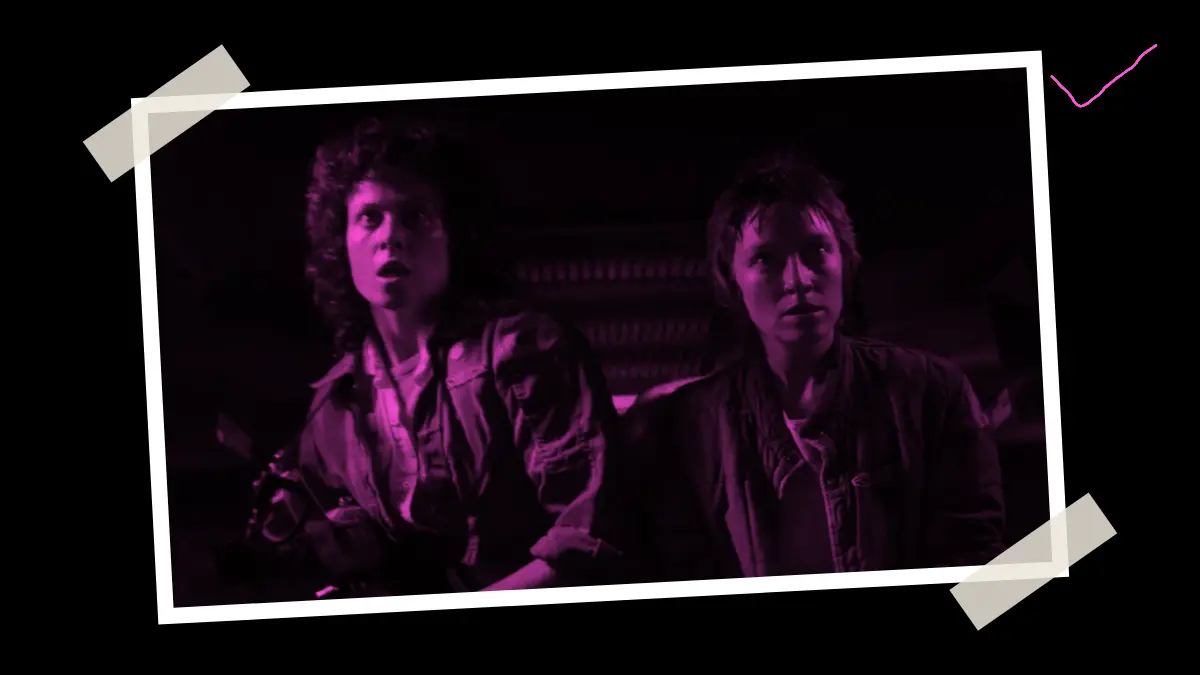 Dec 19, 2015Bechdel Test Script Parser - How It Works, and I rebuilt it in 2026: it reads a screenplay and checks the test’s three rules1, two women, who talk to each other, about something other than a man. I’m the first to admit a computer is a clumsy way to read something as subjective as the Bechdel test. I hand-checked a lot of these results, and it’s hard. I still think it’s worth using what technology lets us do to look at art in new ways, especially around gender, both in front of the camera and behind it.
Two things explain most of it. The fan canon leans on war and crime movies from the 1970s through the 2000s. And on the same films, the ones fans like more than critics do pass less often, which genre doesn’t explain.
By the script, 62% of the films pass. By the readers, who’ve rated 2,314 of them, 53% do, which is about where everyone else lands.1
My parser is more generous than people are. Readers judge whether a real conversation happened between two named women;2 my parser counts any exchange it can find between two women’s characters. So I give both numbers where they differ, and when I quote one, it’s the readers’.
Every fan rating site I could check slopes the same way. bechdeltest.com keeps its own list of the IMDb Top 2502, and only a third of it passes, 84 of 246 films. TMDB’s users and Letterboxd’s show the same slope, though my Letterboxd numbers only cover films I’ve reviewed.
The gap was widest for films from the 1980s and had closed by the 2010s.
The films I review fail more often than most. By the readers’ verdicts, 46% of the 174 films I’ve reviewed pass, against 53% across all the films, and my stars barely sort them: my 4.5- and 5-star films pass about as often as my 3-star ones. Each title below links to my review, and each score to the film’s page on Bechdel Script Test and on bechdeltest.com.
| Film | My rating | Parser | Readers |
|---|---|---|---|
| Fargo (1996) | 5 | 1/3 | 2/3 |
| Moonlight (2016) | 5 | 1/3 | 1/3 |
| The Shining (1980) | 5 | 1/3 | 2/3 |
| Citizen Kane (1941) | 5 | 2/3 | 1/3 |
| Toy Story 2 (1999) | 5 | 1/3 | 1/3 |
| Michael Clayton (2007) | 5 | 2/3 | 2/3 |
| The Big Lebowski (1998) | 4.5 | 1/3 | 1/3 |
I’m from Minnesota, so of course I think Fargo is a perfect movie. It also fails. Marge Gunderson has more lines than anyone else in the script, 214 of them, and she never has a conversation with another woman.
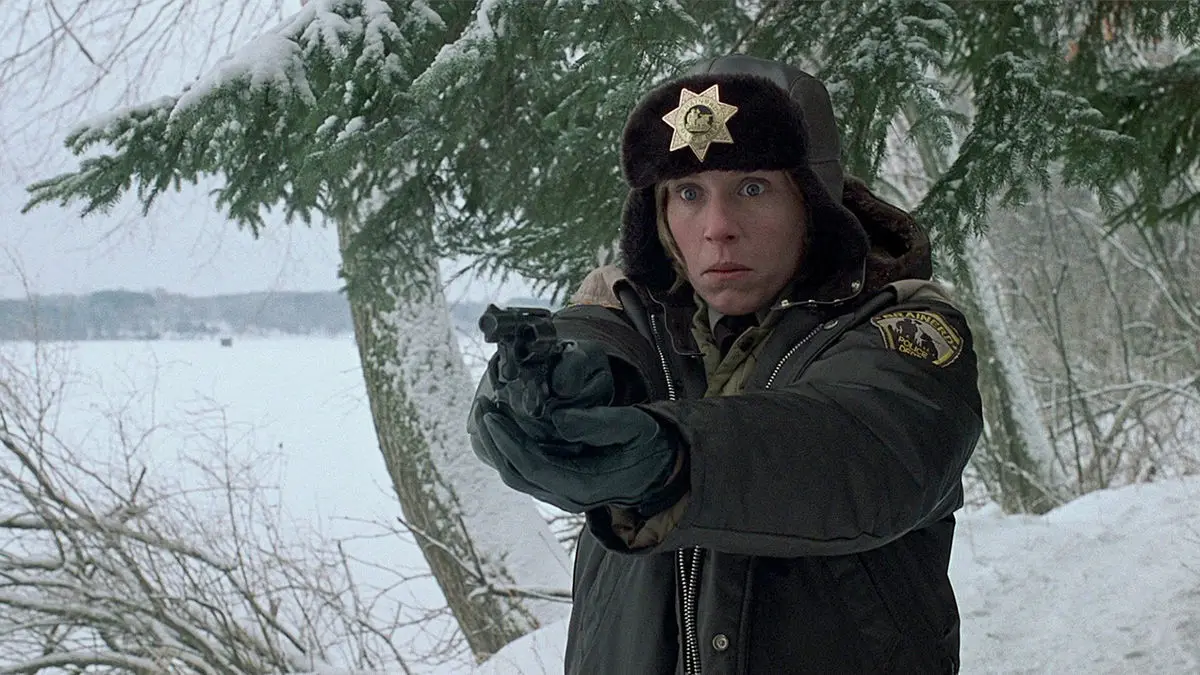
That’s the kind of film the test is good at catching. Fargo is built around a woman, and the script still has 23 conversations between men and none between women.

A film can fail at any of the test’s three rules, and the top-rated films fail at every one of them more often. The biggest jump is the first rule: films rated 8 or higher are almost three times as likely to have fewer than two named women in them at all.

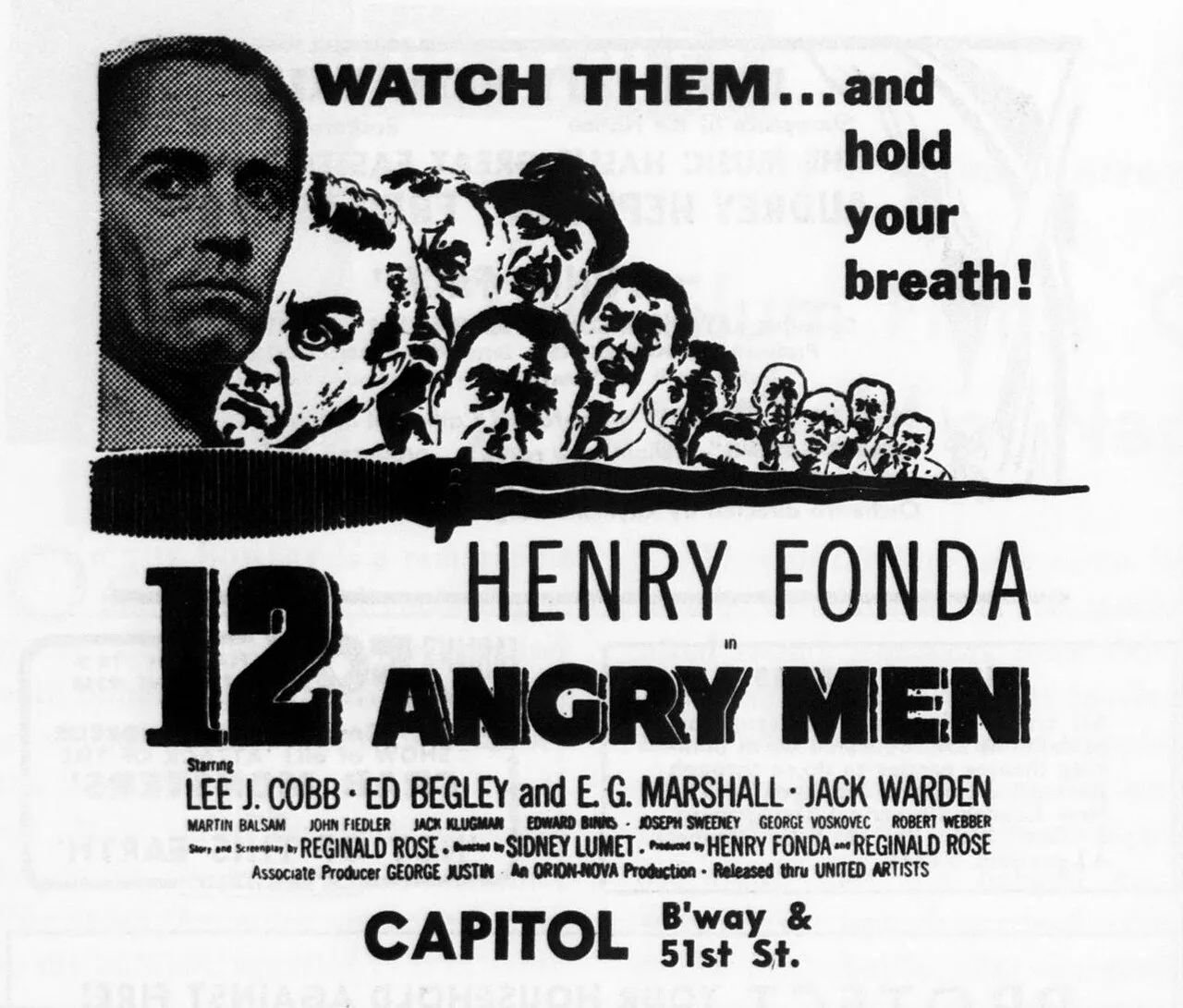
Some of IMDb’s most beloved films don’t give a woman a single line, at least in the scripts I have: 12 Angry Men, Lawrence of Arabia, Paths of Glory, The Great Escape, Dr. Strangelove, The Bridge on the River Kwai, Platoon, The Thing and The Revenant. They’re war movies, prison-camp movies and men-on-a-mission movies, and they’re the backbone of a lot of “greatest films” lists.
The yes-or-no verdict hides how big the difference is. Count who gets the most lines, or how many words women get, and the fans’ favorites fall away from everyone else, while the critics’ favorites barely move. A woman has the most lines in about a third of the films IMDb voters rate under 6, and in one in eight of the films they rate 8 or higher.
In the average script, women are 32% of the speaking characters, a little under the 34.6% USC Annenberg counted on screen in the 100 top-grossing films of 20223. In the films fans rate highest, it’s closer to a quarter, and the longest stretch with no woman speaking runs 12% of the dialogue, against 7% in the films fans rate lowest.
Stephen Follows found in 20144 (“By all four measures, films that fail the Bechdel Test score higher than those that pass.”) that films that fail the test score higher than films that pass, across four rating measures that included critics’ scores. On critics, my data disagrees with him. By the readers’ verdicts, films that score 80 or more on Metacritic pass 55% of the time, against 47% of the films critics score under 50, and Rotten Tomatoes critics land the same way. My parser is flatter, but it shows no fan-sized drop either.
Brian Keegan found the same split in 2014, in a replication FiveThirtyEight wrote up5 (“1.8 more Metacritic points by professional reviewers and 0.12 fewer stars by IMDb reviewers”): passing films had about 1.8 more Metacritic points and a little less on IMDb. So Follows and FiveThirtyEight weren’t contradicting each other: fans and critics reward different films.
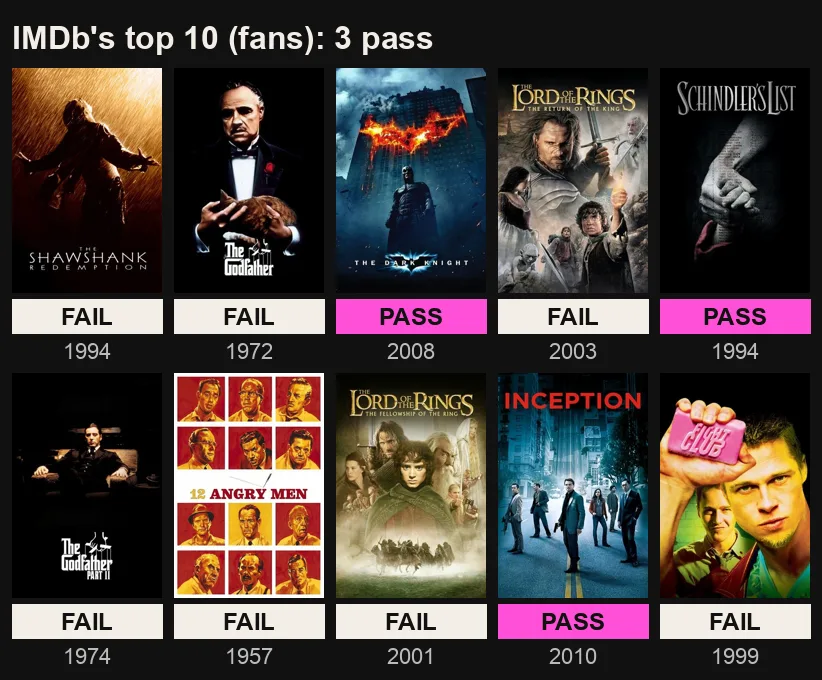
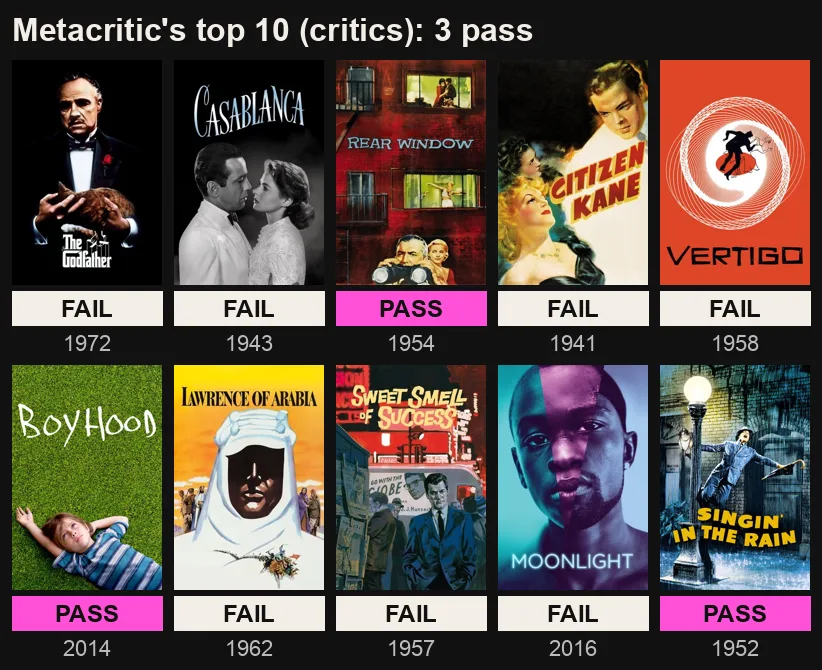
At the top, the two lists look alike. Three of IMDb’s ten highest-rated films pass, and three of Metacritic’s (ties broken by vote count). The critics’ top ten is mostly black-and-white classics like Citizen Kane and Casablanca, and old films fail on every list. The split shows up as the lists get longer: of each site’s 250 highest-rated films that readers have rated, 42% of IMDb’s pass and 55% of Metacritic’s.
 IMDb's top 10 · fans
 Metacritic's top 10 · critics
Genre explains most of why IMDb’s top films fail more than its bottom ones: about 10 points of the 16-point gap between films rated 8 or higher and films rated under 6.5, a wider low band than the intro’s under-6 so each group has enough films. The era, the director and the writer explain 2 or 3 points each.
Fans put war, crime and westerns at the top far more than critics do (30% of IMDb’s 8+ films, 24% of Metacritic’s 80+), and they rarely give an 8 to horror or romance, the two genres that pass most. Browse any of them on Bechdel Script Test: war, crime, horror, romance or every genre’s pass rate.
Genre isn’t all of it. Inside a single genre, the top-rated films still fail more: dramas, comedies and romances rated 8 or higher all pass far less than the rest of their genre.
Genre explains which films fans put at the top. It doesn’t explain the rest.
Plot every film by its Metascore and its IMDb rating, and the films above the diagonal are the ones fans like more than critics do. I split the films into quarters by that gap. The quarter fans like most over critics, films like The Prestige, Fight Club, Se7en, Gladiator, Joker and The Green Mile, passes 44% of the time. The quarter critics like most over fans, like The Godfather, Schindler’s List, GoodFellas, The Truman Show, WALL·E and No Country for Old Men, passes 59%.
Hover or tap a dot to see the film. Every film’s verdict is also on Bechdel Script Test’s film list.
This one isn’t genre. The films fans like more aren’t heavier on war and crime than the ones critics like more, and inside dramas with no war or crime in them the gap holds, 48% against 63%. It also hasn’t closed. Among films from 2010 on, the ones fans like more pass 48% of the time and the ones critics like more pass 66%.
Men do most of the rating on IMDb. When IMDb still showed who voted, its page for 12 Angry Men6 said 86% of the voters who gave a gender were men, and 82% of the voters who gave an age were 18 to 44.
It’s the same across the site. When FiveThirtyEight counted in March 2018, 97 of the 4,377 films7 eligible for IMDb’s Top 250 had more ratings from women than from men. A 2024 study of 383 million IMDb ratings8 found men rate films with a woman in the lead lower than films with a man in the lead, and women’s ratings depend far less on the lead’s gender. IMDb has since removed the age and gender breakdowns.
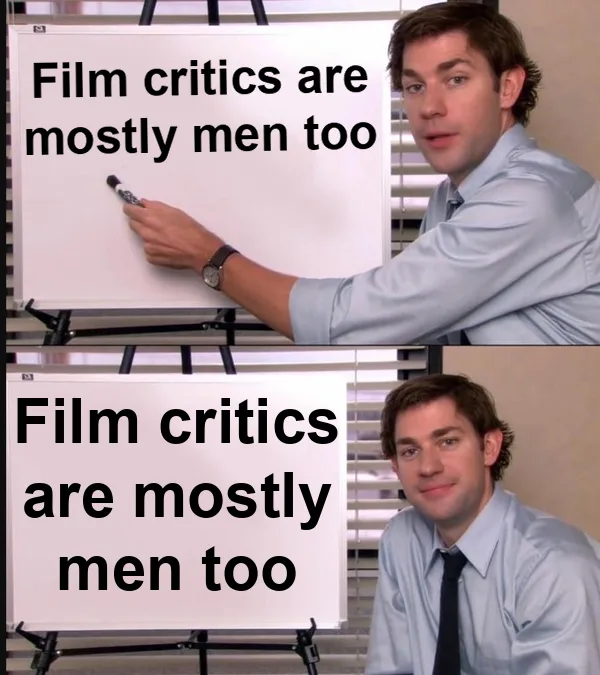
But critics are mostly men too. USC Annenberg found that men wrote 78% of the reviews9 of 2017’s top 100 films on Rotten Tomatoes. So who rates doesn’t explain it on its own. I suspect it’s why they’re rating. A critic is paid to watch whatever comes out that week, including the films fans skip. A fan rates the movies they chose to see and loved enough to log, and I’d guess a crowd of mostly young men keeps choosing stories about men.
Who directs changes whether a single film passes. With a woman credited as director, 86% of films pass, against 50% of films directed only by men, and women get about half the words in the films women direct against a quarter in the films men direct. You can look up every director’s pass rate on Bechdel Script Test.
A woman anywhere in the writing credits does the same: 73% pass, against 46% without one. The Pudding found the same direction in 2017, with all-male writing teams failing about half the time10.
It barely moves the fans’ list, though, because there are so few of those films. Women directed 4 of the 245 films rated 8 or higher. They still direct few big films: 13% of 2025’s 250 top-grossing films, by the Celluloid Ceiling report11.3
For the decade-by-decade cut I compared 8+ films with everything under 6.5, so each decade has enough films (pass rates by decade are on Bechdel Script Test):
| Released | Rated 8+ pass | Rated under 6.5 pass |
|---|---|---|
| 1980s | 24% (21 films) | 63% (52 films) |
| 1990s | 33% (42 films) | 51% (91 films) |
| 2000s | 33% (45 films) | 52% (170 films) |
| 2010s | 63% (43 films) | 56% (193 films) |
By the 2010s the gap between IMDb’s top and bottom films is gone. Only 43 films from that decade reach an 8, so their 63% could be off by about 14 points either way, but there’s no sign of the 1980s gap.
Pass rates climbed across the board too, from 36% for films of the 1970s to 63% for the 2020s. That disagrees with Duke’s finding that the pass rate had been flat near 50% since the mid-1990s12, and agrees with Appel and Gnambs, who found it rising through the 2010s, though my scripts aren’t the same sample as either.
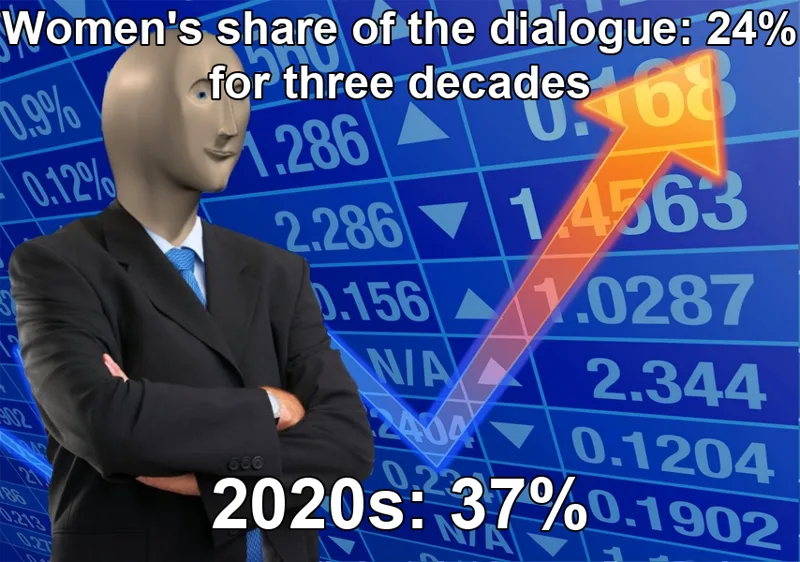
What women get to say moved later. Their share of the words sat at about a quarter from the 1980s through the 2000s, then rose to 37% in the 2020s. Some of that is more women directing, 21% of my 2020s scripts against 1% in the 1970s. More of it is the men’s films changing: in films men directed, women’s share of the words went from 23% in the 2000s to 30% in the 2020s.
Take the 2020s with some salt. The scripts that go online from recent years lean toward awards-season releases, and the Celluloid Ceiling’s 13% for women directors is well under my 21%.
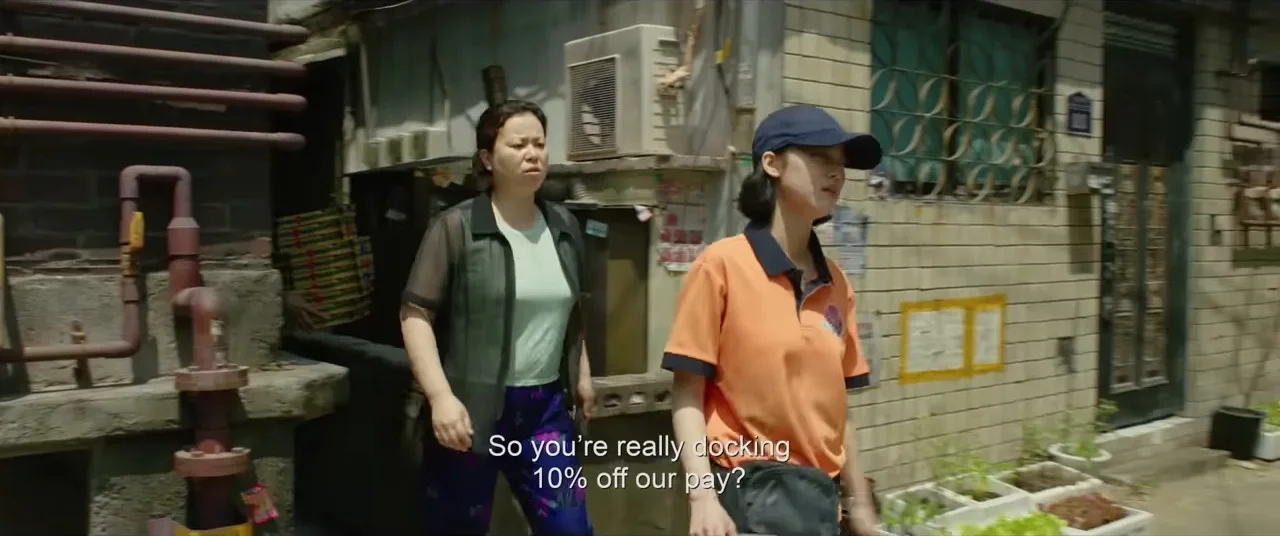
I liked Parasite’s themes of climate change and the wealth gap, and it’s what a fans’ favorite looks like after the gap closed: an 8.5 on IMDb, and a pass by my parser and by the readers, though they mark it disputed. Women speak 46% of its words, and its script has 40 conversations between women against 39 between men. The passing scenes are about money. The mother, Chung-sook, argues with the pizza shop owner who wants to dock her family’s pay for badly folded boxes. In the script she says, “Still, you can’t cut ten percent from my pay.”
Film has been dominated by male directors for a hundred years, and a lot of those men told amazing stories that resonate with me as a cis white man. Some of the films that fail tell stories nobody else was telling. Moonlight, one of the most important films of my life, shows a queer Black experience of masculinity, and it fails by my parser. I’m not surprised, and it doesn’t make Moonlight bad.
The test isn’t a judgment call on any one movie. As I put it in a 2020 talk13 (“this is a lens for us to view film”), it’s “a lens for us to view film,” and “not a dictation of its quality.” What it shows, across thousands of films, is who gets to be on screen, what they’re given to do, and what they’re allowed to talk about.
What I want to know next is whether the all-time list changes. Fans’ favorites from the 2010s pass at least as often as the rest. But the canon people hand you, IMDb’s Top 250 and the movies you have to see, is still mostly war and crime from the 1970s to the 2000s, and new films have to push those off the list. And genre was only part of it. On the same films, fans and critics split further apart in the 2010s, not closer, and I don’t know why yet.
The parser splits a screenplay into scenes and speakers, matches each character to the cast list to get their gender, and checks the three rules scene by scene. The details are in the 2015 postDec 19, 2015Bechdel Test Script Parser - How It Works, on the project page and in my 2020 talk, and the site’s Oscar case study walks through how a verdict gets made:
Women’s share of the words counts the dialogue of characters the parser could gender. “Most lines” means the character with the most lines of dialogue in the script.
The readers’ verdicts are bechdeltest.com ratings for 2,314 of the films. IMDb, Metacritic and Rotten Tomatoes scores come from OMDb, TMDB scores from TMDB for films with 200 or more votes, vote counts from IMDb, and director and writer credits from TMDB. Letterboxd blocks AI crawlers in its robots.txt (as of November 2026), so the Letterboxd numbers only cover the 174 films I’ve reviewed that have a reader verdict, using the average I already store with each review: 43% of the ones Letterboxd rates 4 or higher pass, against 65% of the 20 it rates under 3.3.
My parser and the readers agree on 77% of films. Of the rest, my parser passes 371 films the readers fail and fails 151 they pass. Some of those are scenes that aren’t in the script I have: Jaws and Interstellar pass with readers and fail by the script. Films change a lot between the page and the screen: the median film keeps 42% of its script word for word Nov 24, 2026I compared 2,112 movie scripts with what was actually said on screen. Bad movies threw their scripts out.*.
The genre breakdown is a simple reweighting: I matched the lower-rated films to the 8+ films’ mix of genre, era, director and writer, one at a time. The fans-versus-critics split uses the IMDb rating times ten minus the Metascore, with the quarter boundaries at minus 4 and plus 14. Small groups carry wide margins; the war and sports genres are about 45 films each. The scripts online skew toward famous films, some are drafts, and matching characters to the cast list misses some of them. The data and code are on GitHub with a DOI on Zenodo.
Look up your favorite film on Bechdel Script Test, or start with the numbers behind this post, and see where it lands.
Footnotes
-
bechdeltest.com’s whole list of 11,032 films passes 57.5%, and a study of the 1,200 top-grossing films from 1980 to 2019 found 49.6%. The reverse test, two men talking to each other about something other than a woman, is barely a test at all: 96% of my scripts pass it, and Appel and Gnambs found 95%. ↩
-
bechdeltest.com lists the rules as “At least two [named] women in it”, “Who talk to each other” and “About something besides a man”. The bracketed “named” is part of why readers fail more films than my parser does. ↩
-
Films that pass are cheaper, too. By the readers’ verdicts, the median passing film had a $23 million budget against $30 million for the median failing film, and grossed 3.2 times its budget against 2.8 times. FiveThirtyEight found the same thing in 2014, and Brian Keegan’s replication found the return gap goes away once you control for budget. I didn’t, so all my numbers show is that passing films are cheaper. ↩
Works on My Machine
Get the next post by email. My newsletter covers homelab builds, AI tools and open source, and it goes out when I have something to say.
It’s free, and you can unsubscribe anytime. You’ll get an email to confirm first.
If you liked this post, consider sharing it on Hacker News, Bluesky, LinkedIn, or X.
Joe
Karlsson
Technology is better when it's weird and it's yours. Everything I write about runs in my house.
More about me →