I compared 2,112 movie scripts with what was actually said on screen. Bad movies threw theirs out.*
Blog I lined up 2,112 screenplays with what was said on screen. The further a movie strays from its script, the worse it tends to be rated. Jaws strayed anyway.
TL;DR I lined up 2,112 screenplays, word for word, with the subtitles of the films they became. Films rated under 6 on IMDb kept 30% of their scripts, and films rated 8 or more kept 50%. Some of the best movies ever made threw their scripts out anyway. My read: going off the page is a gamble that usually loses, and the wins need a rare kind of director.
On this page
I lined up 2,112 movie scripts, word by word, with the English subtitles1 of the films they became, to see how much of the plan survives. The typical movie keeps 42% of its script’s dialogue word for word. And the less of its script a movie kept, the worse people tend to rate it.
Going off script is a gamble, and most of the time it loses. The famous wins, like Jaws and Blade Runner, are why it looks like a better bet than it is.
Movies rated under 6 on IMDb kept 30% of their scripts. Movies rated 8 or higher kept 50%. Hover over or tap a dot to find a film. It’s a real pattern with plenty of exceptions2.
Put the films in groups by how much of their script they kept, and the gamble shows up as odds. Here’s the share of each group IMDb voters rate as a flop (under 6) or a classic (8 or higher):
| Script kept | Films | Rated under 6 | Rated 8+ |
|---|---|---|---|
| Under 20% | 352 | 20% | 5% |
| 20% to 40% | 640 | 15% | 7% |
| 40% to 60% | 578 | 12% | 10% |
| 60% to 80% | 325 | 4% | 11% |
| 80% or more | 217 | 3% | 16% |
So a film that kept under 20% of its script is about seven times as likely to be a flop as one that kept 80% or more, and about a third as likely to be a classic. The top group is where some of the scripts online are really transcripts, but leave it out and the gap still holds: 15% flops among films that kept 20% to 40%, against 4% among films that kept 60% to 80%.
Famous movies might just have better scripts online: studios publish polished final versions of their prestige films, and those match the screen better than an early draft would. So I compared like with like.
The study has 640 shooting scripts3 and 131 early drafts, and better-rated films keep more of their scripts in both. It holds for films from before 1990, from 1990 to 2009, and from 2010 on, and inside every big genre, from dramas to action movies. Here’s the share of the script kept word for word, as a median:
| IMDb rating | Films | All | Shooting | Early drafts |
|---|---|---|---|---|
| Under 6 | 249 | 30% | 32% | 15% |
| 6 to 7 | 768 | 38% | 38% | 23% |
| 7 to 8 | 899 | 47% | 47% | 35% |
| 8 and up | 196 | 50% | 51% | 45% |
The flops at the bottom of the rating chart left a trail.
Inspector Gadget kept 7% of its script. Rupert Everett, who played the villain, wrote in his memoir, Red Carpets and Other Banana Skins (2006), quoted by Den of Geek, that “a string of writers had written version after version, each adding to our scripts on a different-colored paper,” for “a panel of executives, each with their own theory and agenda.” After bad test screenings, the film was cut from 110 minutes to 78.
Battlefield Earth kept 17%, and IMDb voters rate it 2.5 out of 10. The script went through ten revisions before another writer was brought in. When the original writer, J.D. Shapiro, accepted its Razzie for Worst Picture of the Decade, he thanked that writer for rewriting his script in a way he “never, ever, ever” could have imagined.
How much of the script survives depends a lot on what kind of movie it is. Comedies, for all their improvising, keep 42% of their scripts, right at the average. Action and war movies keep the least, and animation keeps by far the most.
You can have two animators working for three and half months to animate a scene.Pierre Perifel, director of The Bad Guys, in TV Tech, 2022
Animated films keep 88% of their scripts because they’re made backwards. Ken Schretzmann, who edited Toy Story 3, put it this way: “In live-action, you shoot first and edit later. In animation, you edit first and shoot later.” The rewriting happens in story reels: Pete Docter has described filming the storyboards with temporary dialogue and music, and watching the story change again. Once a scene’s real dialogue is recorded, it goes to the animators, and from then on changes are expensive, since two animators can spend months on one scene4. Even Robin Williams’s famous improvising on Aladdin happened in the recording booth, before anything was animated.
You can have two animators working for three and half months to animate a scene.Pierre Perifel, director of The Bad Guys, in TV Tech, 2022
If we sat around and waited for the script to be finished, we’d still be developing this movie.Christopher McQuarrie on Mission: Impossible - Fallout, Collider, 2018
Action films keep 33% because the script often isn’t finished when shooting starts. McQuarrie says “Screenplays are the afterthought to the decision to make a movie,” and on Fallout: “I’m not going to start writing until I know where I’m shooting5.” Kevin Feige has said Marvel shoots additional material on all of its movies after the main shoot. When the stunts and locations come first, the dialogue gets written around them, late, with no finished script to fall back on.
If we sat around and waited for the script to be finished, we’d still be developing this movie.Christopher McQuarrie on Mission: Impossible - Fallout, Collider, 2018
Comedies land in the middle because they keep the scripted take as insurance. On Judd Apatow’s productions, the rule is to shoot at least one take of a scene as scripted, then keep the cameras rolling for variations, and Adam McKay says he makes sure “to have alts no matter what.” The structure stays, and the jokes get swapped. Bridesmaids kept 6% of its script, which is what happens when the alternates win. Paul Feig has said, “I like when they will just go off.”
Who’s in charge matters too. When the person who wrote the script also directs it, a film keeps 49% of its script (974 films), against 37% when someone else directs (1,138 films).
[S]urvivorship bias is your tendency to focus on survivors instead of whatever you would call a non-survivor depending on the situation.David McRaney, You Are Not So Smart, 2013
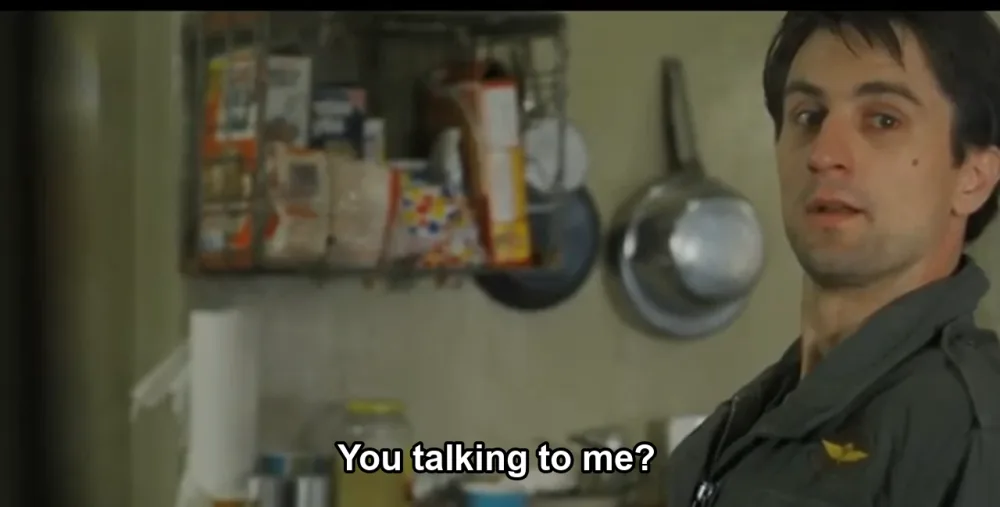
The wins are famous and the losses are forgotten6. Nobody tells stories about what got rewritten on Inspector Gadget, so going off script looks a lot better than it is. It’s survivorship bias, the same mistake as studying only the planes that made it home. And some of the best movies ever made do sit at the bottom of that first chart. Apocalypse Now kept 10% of its script, Taxi Driver 27% and The Truman Show 19%. De Niro improvised “You talkin’ to me?” in rehearsal, according to his own annotated script.
[S]urvivorship bias is your tendency to focus on survivors instead of whatever you would call a non-survivor depending on the situation.David McRaney, You Are Not So Smart, 2013
Blade Runner is the clearest case. It kept 19% of its script. The one in the study is Hampton Fancher’s draft, and in it Roy Batty never gives a speech. He pulls a nail out of the wall, hands it to Deckard, and tells him to stick it in his ear. Deckard shoots him a few lines later.
Three words made it: “time to die.” David Peoples rewrote Fancher’s script and gave Batty a speech. Then Rutger Hauer called the scripted speech opera talk7, cut it down the night before they filmed, and added the line about tears in rain. It’s one of the most quoted speeches in film.
I’ve reviewed 127 of these films on this site, and my favorites are full of these exceptions: Jaws, The Truman Show, Alien and Interstellar all kept less than a third of their scripts, and I gave Jaws and The Truman Show five stars.
When going off script works, I suspect it takes a director who can hold a sprawling, improvised, constantly changing shoot together and still come out with a movie. Even they don’t manage it every time.
He was on set every day and would literally rewrite a scene the night before they shot it.Edwin Cannistraci on Carl Gottlieb, Final Draft, 2025
Jaws was written while it was shot. The mechanical shark kept breaking down (American Cinematographer reported a week’s delay during the shoot “while Bruce got a nose job”), and Carl Gottlieb would rewrite a scene the night before8 they shot it. Its most famous line isn’t in the script I have. Gottlieb says Roy Scheider ad-libbed it on set. Who came up with it is disputed9, but every version of the story has it coming from the set, not the page.
He was on set every day and would literally rewrite a scene the night before they shot it.Edwin Cannistraci on Carl Gottlieb, Final Draft, 2025
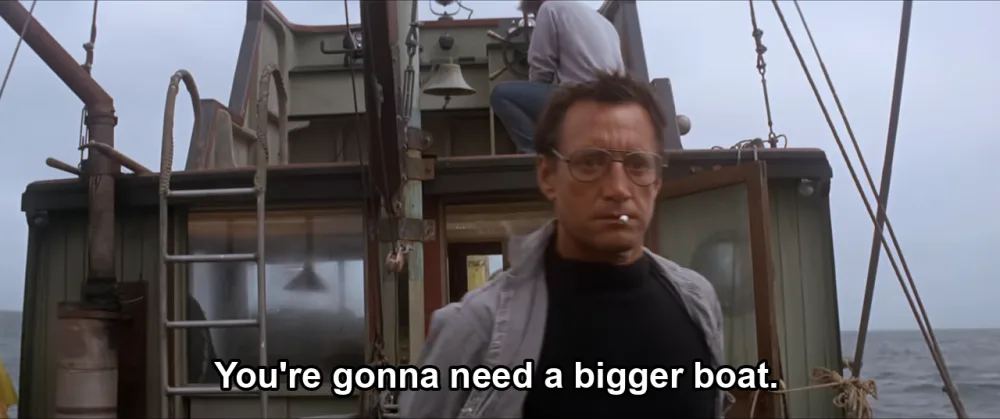
On Jaws, Spielberg called the shoot “a mathematician’s dream and a filmmaker’s horror,” and came out with a classic. He doesn’t every time. His films run from 7% of the script kept (The Post) to 96% (War Horse). Some of the ones that strayed furthest from the page are among his best, like Saving Private Ryan (8% kept) and Jaws. Others, like The BFG and The Lost World: Jurassic Park, are among his lowest rated.
The Coens and Billy Wilder stay close to the page almost every time: 17 of the Coens’ 19 films keep more than 60% of their scripts. Spielberg’s range is the widest of the six.
Christopher McQuarrie works the same way on the Mission: Impossible films. On Rogue Nation he told Film Comment, “I was constantly rewriting the script and trying to find the end of the movie,” and it worked. Simon Pegg described the later films as “a fly by the seat of your pants way of working,” and the last one, The Final Reckoning, didn’t work for me.
When you hear that a movie was “found on set” or rewritten through the shoot, the odds are against it. What subtitles can’t tell me is which way it runs: whether rewriting sinks films, or troubled productions both rewrite and turn out badly.
I didn’t set out to study script rewrites. I run Bechdel Script Test, which checks 3,711 movies against the Bechdel test10 by reading their scripts Dec 19, 2015Bechdel Test Script Parser - How It Works (as of November 2026), and the first thing anyone says about it is that the script isn’t the movie. This was my way of checking. The words change a lot, but the verdict mostly doesn’t: it holds for about 95% of the 1,699 films checked against bechdeltest.com readers who rated the released movies.
For each film I took the share of the script’s dialogue words that turn up in the English subtitles in the same order. A reworded line counts as lost, so this measures exact wording, not plot. Subtitles shorten speech, so I listened to 100 lines my tool called cut or reworded, in the films themselves; about nine in ten really were.
The limits: subtitles aren’t a transcript, and “not in the script” means not in the draft I had. A single film’s score depends on which version of its script is online: Judd Apatow’s Knocked Up kept 96% of its script and his Funny People 11%, and the Knocked Up script online is probably a transcript11, so trust the patterns more than any one dot. Scripts online skew popular, American and recent. Ratings are IMDb’s, as of November 2026. I couldn’t find a good explanation for why war and sport movies sit at the bottom with action. The method and every check are in METHODS.md.
Show all 17 films
| Film | Kept | IMDb | Year | My review |
|---|---|---|---|---|
| Shrek | 97% | 7.9 | 2001 | |
| The Princess Bride | 97% | 8.0 | 1987 | |
| Up | 96% | 8.3 | 2009 | |
| The Dark Knight | 77% | 9.1 | 2008 | |
| The Shawshank Redemption | 71% | 9.3 | 1994 | |
| Taxi Driver | 27% | 8.2 | 1976 | |
| Jaws | 26% | 8.1 | 1975 | 5 stars |
| Alien | 22% | 8.4 | 1979 | 4.5 stars |
| Blade Runner | 19% | 8.1 | 1982 | |
| The Truman Show | 19% | 8.2 | 1998 | 5 stars |
| Anchorman | 18% | 7.1 | 2004 | 4.5 stars |
| Battlefield Earth | 17% | 2.5 | 2000 | |
| Step Brothers | 15% | 6.9 | 2008 | |
| Apocalypse Now | 10% | 8.4 | 1979 | |
| Interstellar | 9% | 8.7 | 2014 | 4.5 stars |
| Inspector Gadget | 7% | 4.2 | 1999 | |
| Bridesmaids | 6% | 6.8 | 2011 |
Show all 13 sources
- American Cinematographer, “On Location With Jaws”, March 1975.
- Boston Magazine, Carl Gottlieb interview, 2015.
- Final Draft, “Jaws: a masterpiece created by collaboration and deadline”, 2025.
- Harry Ransom Center, “You talkin’ to me?”, 2016.
- Wikipedia, Battlefield Earth and Tears in rain monologue, and the sources they cite.
- Rupert Everett, Red Carpets and Other Banana Skins (Little, Brown, 2006), as quoted in Den of Geek, “1999’s Inspector Gadget”, 2017.
- Frame.io Insider, “Edit First, Shoot Later”, 2019; A.V. Club, Pete Docter interview, 2009; TV Tech, “The making of The Bad Guys”, 2022; Variety, Ron Clements on Robin Williams, 2021.
- Film Comment, Christopher McQuarrie interview, 2015; Variety, Simon Pegg on the Mission: Impossible scripts, 2023.
- DGA Quarterly, “Apatow & Friends”, 2009; Paste, Adam McKay interview, 2013; CinemaBlend, Paul Feig interview, 2011.
- David McRaney, “Survivorship Bias”, 2013.
Works on My Machine
Get the next post by email. My newsletter covers homelab builds, AI tools and open source, and it goes out when I have something to say.
It’s free, and you can unsubscribe anytime. You’ll get an email to confirm first.
If you liked this post, consider sharing it on Hacker News, Bluesky, LinkedIn, or X.
Joe
Karlsson
Technology is better when it's weird and it's yours. Everything I write about runs in my house.
More about me →