|8 min read
Cloud Centers of Excellence (Part 3): FinOps, Cost Management, and Real-World Case Studies
About This Series: This is Part 3 of our 5-part series on Cloud Centers of Excellence (CCOEs). Catch up on previous parts:
- Part 1: Introduction and Organizational Structure
- Part 2: Governance, Security, and Compliance
- Part 3 (This post): FinOps, Cost Management, and Case Studies
- Part 4: Implementation Best Practices and Common Pitfalls
- Part 5: The Future of CCOEs and Getting Started
Note: TL;DR: Managing cloud spend has overtaken security as the #1 cloud challenge, with 82% of organizations citing cost management as their top priority. Modern CCOEs have evolved to embed FinOps practices, implementing tagging standards, chargeback mechanisms, and automated cost optimization that can save millions annually. Real-world case studies from Capital One, Commerzbank, and other major enterprises demonstrate how mature CCOEs strike a balance between innovation and financial discipline, achieving 20-40% cost reductions while accelerating time-to-market by 30%. The rise of dedicated FinOps teams (now in 59% of organizations) often stems from initial CCOE cost governance efforts.
As cloud usage scales, controlling cost and ensuring financial accountability become major concerns, giving rise to FinOps (Cloud Financial Operations) as a discipline. A critical role of modern CCOEs is to implement FinOps practices and embed cost governance into cloud management. In many organizations, the CCOE either houses a FinOps function or closely coordinates with a dedicated FinOps team to drive cost optimization and accountability.
Cloud Cost Management as a Top Challenge
Cloud costs can spiral without proper oversight, idle resources, over-provisioning, and a lack of visibility often lead to waste. Industry surveys over the past few years have underscored this challenge. By 2022, managing cloud spend had surpassed security as the number one cloud challenge reported by enterprises. In Flexera’s 2023 survey, 82% of respondents cited cost management as a top challenge, edging out security (77%). Correspondingly, “optimizing existing cloud use (cost savings) has been the top initiative for seven years running” (reported by 62% of organizations in 2023). This shift has elevated FinOps from a niche practice to a mainstream component of cloud governance.
The CCOE is often tasked to ensure cloud cost governance through FinOps. In some companies, this means the CCOE includes a FinOps specialist or cost manager, while in others, the CCOE works in partnership with a formal FinOps team. Either way, the objectives are to achieve cost visibility, optimize spending, and instill financial accountability for cloud consumption.
Key FinOps Practices via CCOE
According to the FinOps Foundation and industry glossaries, a CCOE enables FinOps by centralizing cost policies and tooling. Some core functions include:
-
Establishing Cost Visibility and Allocation: CCOEs implement tagging standards and cost allocation models so that every cloud cost is traceable to an owner (team, project, or business unit). For example, the CCOE may enforce that all cloud resources have tags like
Environment,Application,CostCenter, etc., enabling precise Showback/chargeback reports. They often deploy cloud cost dashboards and reporting tools (e.g. AWS Cost Explorer, Azure Cost Management, or third-party tools like Cloudability) to provide real-time visibility into spend. By doing so, the CCOE makes sure each team can see and be accountable for its cloud usage. -
Budgeting and Forecasting: The CCOE/FinOps function sets up cloud budgeting processes, working with finance to assign cloud budgets to departments or projects, and implementing alerts for budget thresholds. They use historical data to forecast future spend and inform business planning. For instance, if a new product is launching, the CCOE might help estimate the cloud costs for scaling it to millions of users. They also track budget vs actuals and investigate discrepancies, which feeds back into better forecasting models.
-
Cost Optimization and Efficiency: CCOEs lead initiatives to reduce waste. This includes identifying idle or underutilized resources (e.g., VMs with low utilization, orphaned storage volumes) and recommending or automating their rightsizing or removal. They often implement automated policies like shutting down dev/test environments during off hours, using autoscaling to match capacity to demand, and purchasing reserved instances or savings plans for steady workloads. A CCOE will also evaluate new pricing options and instance types for cost savings (for example, encouraging use of AWS Graviton instances or spot instances where suitable). These technical cost optimizations can yield significant savings, it’s common for a CCOE to report on how much cost avoidance or reduction they achieve quarterly.
- FinOps Culture and Accountability: Beyond tools, CCOEs work to create a culture of cost accountability. They do this by establishing KPIs such as cost per customer or cost per transaction, which tie cloud spending to business value. Regular cost review meetings might be held with each product team (“Cloud cost clinics”) to go over their usage and share optimization tips. The CCOE often publishes guidelines and best practices for developers, for example, advising engineers to choose cost-effective services, to use serverless or managed services when they reduce ops overhead, and to design applications to be cost-aware (like cleaning up temporary resources). In effect, the CCOE evangelizes FinOps across engineering, finance, and product teams, reinforcing that managing cloud spend is a shared responsibility.
FinOps Team Integration
A notable development is the rise of dedicated FinOps teams in large organizations. The latest Flexera State of the Cloud reports indicate a steady increase in companies with FinOps teams. In 2022, about half of the surveyed companies had a FinOps team; by 2023/24, that number grew, and 59% of organizations had a FinOps team in 2024, up from 51% a year prior (see Figure 3). Often, these FinOps teams either reside within the CCOE or work hand-in-hand with it. For example, a bank might have a FinOps group under the CFO, but that group works closely with the Cloud CoE under IT, the CoE provides the cloud expertise and tooling, while FinOps brings financial rigor and reporting structures.
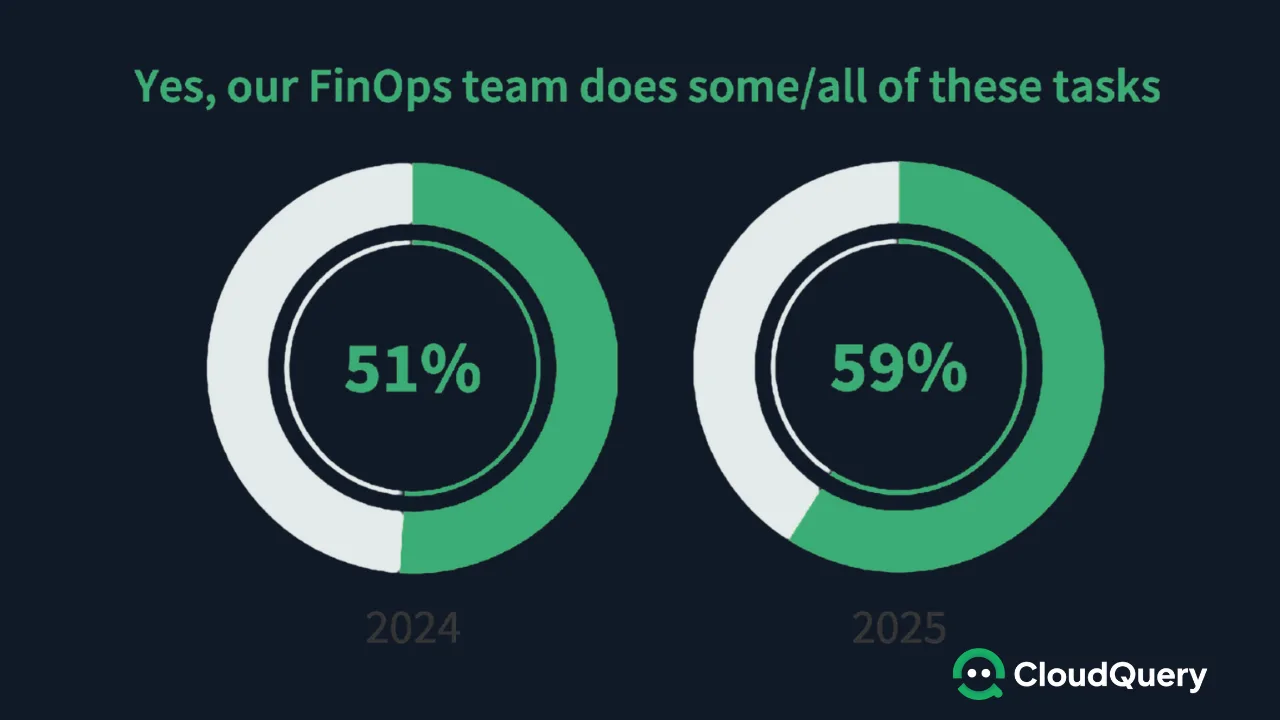
Figure 3: Percentage of organizations with a FinOps team (51% in 2024, increasing to 59% in 2025).** This trend demonstrates growing recognition of the need for formal cloud cost governance. A Cloud CoE often seeds the creation of a FinOps practice by highlighting cost issues and setting up initial governance; as maturity grows, a specialized FinOps team can take on the day-to-day financial management, reporting into the CoE governance framework. In many cases, the CCOE charter explicitly includes “cost optimization” as one of its primary objectives, meaning the CoE is accountable to leadership for maintaining cloud economics.
Chargeback/Showback and Accountability Structures
To drive accountability, CCOEs implement chargeback (billing business units for their cloud usage) or Showback (showing usage costs without actual billing, for transparency). Kyndryl notes that with a cloud CoE, “budget and resource management improves for cloud cost allocation, tagging, and cost charge-backs and show-backs to business units, ensuring complete cost transparency”. The effect is that business leaders see the real costs of the services they consume, which often incentivizes them to support optimization efforts. For instance, a product manager who sees a chargeback report that their application spent $100k on cloud last month (with a spike over budget) is more likely to prioritize cost-efficiency improvements. The CCOE may govern the chargeback model, determining how shared costs (such as networking or support costs) are allocated and ensuring they are perceived as fair and accurate.
FinOps Tools and Automation
CCOEs also select and manage tools for FinOps: this might include cloud cost management platforms (e.g., CloudHealth, Flexera, Apptio Cloudability) and implementing automation like automated alerts for anomalous spending (e.g., if a daily spend exceeds baseline by X%, trigger notification). Some organizations take it a step further with policy engines that can, for example, shut down resources that violate cost policies (such as an unapproved instance type being spun up). Google Cloud’s native recommendation system or AWS’s Cost Anomaly Detection are often leveraged through the CoE to catch inefficiencies automatically. The CoE can aggregate these across multi-cloud environments as well, using multi-cloud cost dashboards if the company uses more than one provider. Flexera’s 2023 report found that among large enterprises, usage of multi-cloud cost management tools (FinOps tools) slightly exceeded usage of multi-cloud security tools (68% vs 63%), indicating that cost optimization is now a prominent focus of tooling investments, on par with security.
Case in Point
Consider a large European bank’s CCOE, which set a goal to reduce cloud waste by 20% in a year. The CCOE’s FinOps unit analyzed cost reports and identified hundreds of idle development virtual machines and over-provisioned databases. By implementing an organization-wide “cleanup day” and deploying an automation script to delete unattached storage, they were able to save a significant sum. They also renegotiated contracts with their cloud provider for committed use discounts (something a CoE can do at an enterprise level). According to Flexera’s data, an estimated 27% of enterprise cloud spend is wasted on average. A capable CCOE/FinOps effort targets that waste, turning it into savings or more efficient spending. Many companies report multi-million-dollar savings after establishing FinOps governance. For example, having engineers accountable for costs led to rightsizing, which saved one company 40% on certain workloads.
In essence, FinOps has become a core pillar of CCOEs. Through a mix of policy (central tagging standards, budgets), process (cost reviews, training), and tooling (dashboards, alerts, automation), the CCOE ensures that the benefits of cloud’s flexibility do not come at the expense of financial discipline. This addresses a key concern of CIOs and CFOs alike: that cloud spend remains aligned with business value. It also fosters a partnership between IT and Finance, a cultural shift where engineers start thinking about cost (traditionally a finance concern), and finance teams become more agile in understanding IT consumption. The Cloud CoE, straddling both worlds, is the ideal entity to facilitate this cross-functional collaboration for cost governance. As one FinOps slogan puts it: “Finance and Engineering in collaboration,” that is exactly the kind of collaboration a CCOE can institutionalize.
Key Takeaways
The evolution of CCOEs to embrace FinOps reflects a fundamental shift in cloud maturity. What started as a technology adoption challenge has become a financial management discipline. The most successful CCOEs we’ve examined don’t just manage cloud costs - they create a culture of financial accountability that spans engineering, finance, and business teams.
The case studies reveal several critical success patterns:
- Quantified outcomes that tie cloud governance to business value
- Cultural transformation that makes cost awareness part of engineering DNA
- Automation-first approaches that scale governance without creating bottlenecks
- Cross-functional collaboration that breaks down traditional IT and finance silos
As we’ve seen, mature CCOEs can deliver transformational results: 20-40% cost reductions, 30% faster time-to-market, and millions in annual savings. But these outcomes require more than just good intentions, and they demand systematic implementation of proven practices.
Coming Up
In Part 4 of this series, we’ll provide the tactical roadmap for building your own CCOE. We’ll cover the step-by-step implementation process, common pitfalls that can derail your efforts, and specific strategies for avoiding the “cloud gatekeeper” trap that has plagued many organizations. Whether you’re starting from scratch or improving an existing CCOE, Part 4 will give you the practical guidance you need.
Continue to Part 4: Implementation Best Practices and Common Pitfalls

Joe Karlsson
Developer Marketing Engineer at CData, leading developer growth for the managed MCP platform that connects AI agents to live enterprise data. Writing about databases, self-hosting, and the things I build. Runs a 60+ container Proxmox homelab with AI-powered automations.
cat newsletter.md
I write a weekly newsletter about databases, self-hosting, and whatever I'm building.
Subscribe on Substack →Related Posts
Jun 3, 2025
Cloud Centers of Excellence (Part 1): Building Effective Cloud Governance Through Strategic Organization
Discover how to build a successful Cloud Center of Excellence (CCOE) to drive cloud governance, security, and innovation across your enterprise. Learn key structures, roles, and strategies in Part 1 of our 5-part implementation series.
Jun 3, 2025
Cloud Centers of Excellence (Part 2): Governance, Security, and Compliance in CCOEs
Who actually owns cloud policy? We break down how real CCOEs manage governance, enforce security without compromising velocity, and keep regulators at bay. We share what works and what quietly fails, inside enterprises handling sensitive workloads.
Jun 3, 2025
Cloud Centers of Excellence (Part 4): Implementation Best Practices and Common Pitfalls
Part 4 of the Cloud CoE series: a battle-tested roadmap covering what to build first, what to skip, how to avoid the ivory tower trap, and keeping your CoE alive past year one.