|20 min read
Cloud Centers of Excellence (Part 4): Implementation Best Practices and Common Pitfalls
About This Series: This is Part 4 of our 5-part series on Cloud Centers of Excellence (CCOEs). Catch up on previous parts:
- Part 1: Introduction and Organizational Structure
- Part 2: Governance, Security, and Compliance
- Part 3: FinOps, Cost Management, and Real-World Case Studies
- Part 4 (This post): Implementation Best Practices and Common Pitfalls
- Part 5: The Future of CCOEs and Getting Started
Note: TL;DR: Building a successful CCOE requires more than good intentions - it demands systematic execution. This implementation guide covers 12 critical steps from securing executive sponsorship to establishing metrics, while highlighting the most common pitfalls that cause CCOEs to fail. Key success factors include treating the CCOE as an enabler (not a gatekeeper), starting with pilot projects, fostering cross-organizational collaboration, avoiding disconnection from operational teams. Organizations that follow these proven practices report faster cloud adoption, improved security posture, and significant cost savings, while those that skip foundational steps often see their CCOEs dissolved within 18 months.
If you’re thinking about establishing a CCOE (or improving an existing one), let me walk you through what actually works based on real-world implementations. Drawing from analysis of cloud providers (AWS, Azure, GCP), industry frameworks, and lessons learned from real-world case studies, here’s a structured approach an organization can follow:
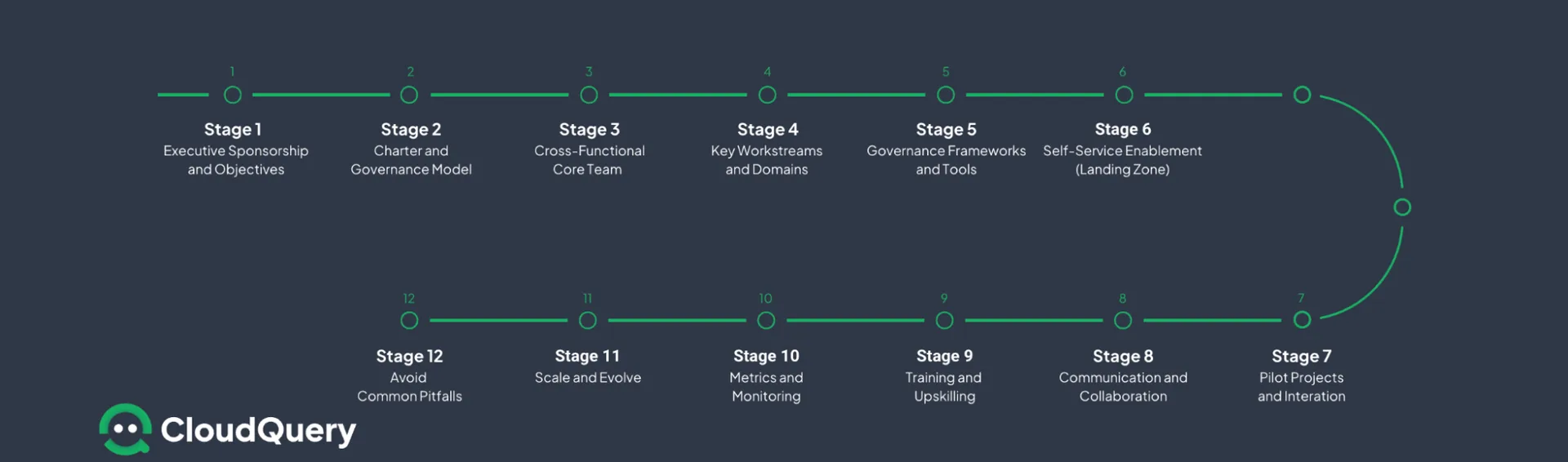
Figure 5: Diagram of a 12-step roadmap for building a Cloud Center of Excellence (CCOE), arranged in a snaking vertical-horizontal flow with white arrows and text.
Step 1: Establish Executive Sponsorship and Clear Objectives
Here’s the honest truth: executive sponsorship isn’t just helpful, it’s essential. I’ve seen too many CCOEs struggle because they lacked the authority to actually enforce their recommendations. The foundation of a successful CCOE is strong executive backing and a well-defined mission. Secure a C-level sponsor (e.g., CIO, CTO) who will champion the CCOEs cause and allocate necessary resources.
Work with this sponsor and key stakeholders to define the CCOEs objectives and scope. Common objectives include: improving cloud security and compliance, optimizing cloud costs, accelerating cloud adoption for business agility, and fostering innovation. Articulate how the CCOEs success will be measured (KPIs), for example, reduction in time to provision infrastructure, percentage of workloads compliant, cost savings achieved, number of staff trained, etc.
Step 2: Develop a CCOE Charter and Governance Model
Create a formal charter document for the CCOE. This should outline the CCOEs mission statement, its authority and decision rights, responsibilities, and its relationship with other organizational units. For instance, specify what decisions the CCOE can make autonomously (setting cloud policies, approving architectural patterns) and where it plays an advisory role.
Define governance mechanisms: will there be a steering committee or cloud council? How will the CCOE interface with existing IT governance, security committees, or architecture review boards? Many
organizations establish a Cloud Steering Committee that includes senior executives and meets quarterly to review cloud strategy, with the CCOE leader as a key member. Also decide on the funding model, is the CCOE budget centralized or funded by contributions from business units? If the CCOE will manage cloud accounts and maybe do chargebacks, that needs clarity up front.
A well-communicated charter prevents overlaps and turf wars; it sets expectations that, for example, the InfoSec team still sets security policy but does so in conjunction with the CCOE for cloud specifics, etc.
Step 3: Assemble a Cross-Functional Core Team
Build the CCOE team by drawing experts from across the organization. Key roles to include:
- Cloud Architect(s): overall cloud infrastructure design and architecture standards
- Security Specialist: cloud security and compliance lead
- FinOps/Cost Specialist: responsible for cost governance and optimization
- DevOps/Cloud Engineer: to implement automation, CI/CD, and tooling
- Data/Analytics Architect: if data workloads are significant, to advise on cloud data services
- Business Relationship Manager or Analyst: someone who can interface with business units, understand their needs and translate to cloud solutions
- Compliance Officer: especially for regulated sectors, to ensure industry-specific requirements are addressed (PCI, HIPAA, GDPR, etc.)
These can be full-time dedicated members or, if that’s not immediately possible, dotted-line members from relevant departments (with a plan to eventually have full-time focus). Ensure diversity in the team, not just IT ops folks, but developers and business-savvy members too. AWS recommends including representatives from IT, security, finance, compliance, and operations in the CCOE.
It’s also a practice to start with a small, nimble team (even 5-7 people) rather than an unwieldy committee, then expand as needed. Define the lead, typically a CCOE Manager or Director who coordinates the team’s work. This person should have enough seniority or support to liaise with vice presidents and enforce decisions.
Step 4: Define Key Work streams and Domains
Within the CCOE, establish sub-teams or work streams for major focus areas. For example:
- Cloud Governance & Architecture: to define reference architectures, cloud design patterns, account structure, networking topology, etc.
- Security & Compliance: to develop security baselines, identity management, encryption standards, compliance controls, and incident response procedures for cloud.
- FinOps & Cost Management: to handle tagging standards, cost monitoring, budget management, and optimization projects.
- Cloud Operations & Tools: to manage common infrastructure (landing zone, CI/CD pipelines, monitoring tools) and define SRE practices for cloud.
- Training & Enablement: to run cloud training programs, documentation, knowledge base, and maybe a Cloud Community of Practice.
Assign a practice owner or lead for each domain (these could correspond to roles above, e.g., the security specialist leads Security work stream). This structure was reflected in AWS’s example, where practice owners with product and tech leads deliver projects in each area. Having focused streams ensures each important area gets adequate attention and expertise.
Step 5: Implement Cloud Governance Frameworks and Tools
Early in the CCOEs life, establish the governance frameworks. This means developing concrete policies and technical controls. But here’s where many CCOEs get stuck: you can’t govern what you can’t see. Before you can implement any governance framework effectively, you need full visibility into your actual cloud environment.
This is where a tool like CloudQuery becomes invaluable for your CCOE implementation. CloudQuery provides the foundational visibility layer that makes everything else possible, automatically discovering and cataloging every resource across your AWS, Azure, GCP, and other cloud accounts. Instead of spending months manually inventorying your cloud assets or relying on incomplete spreadsheets, your CCOE can have real-time cloud asset inventory from day one.
Prioritize creating:
- Cloud Security Baseline: e.g., multi-factor auth on accounts, mandatory encryption, approved regions list, logging standards. Possibly implement a baseline using cloud provider config frameworks (AWS Organizations SCPs, Azure Policy, GCP Organization Policies). CloudQuery can continuously monitor compliance with these baselines, automatically flagging deviations like unencrypted databases or publicly accessible S3 buckets before they become security incidents.
- Compliance Mappings: map regulations like GDPR, PCI, etc., to cloud controls and document how compliance will be assured. For instance, if GDPR requires data access logging, ensure CloudTrail or equivalent is configured for relevant services.
- Resource Tagging Policy: decide what tags are required (owner, environment, etc.) and enforce via scripts or checks. This feeds into FinOps. CloudQuery automatically identifies untagged resources and can track tagging compliance across your entire cloud estate, making it easy to enforce tagging policies and ensure proper cost allocation.
- Networking and Access Architecture: define how cloud networks connect to on-prem (hybrid connectivity), segmentation, use of firewalls or security groups, etc., with an eye to both security and performance. CloudQuery provides visibility into your actual network configurations, helping you identify security group misconfigurations, overly permissive access rules, or network architectures that don’t align with your security standards.
- CI/CD and Automation Standards: pick or build automation pipelines that teams will use. E.g., provide Jenkins pipelines or GitHub Actions templates pre-configured for cloud deployments, to encourage consistency and reduce reinventing the wheel. CloudQuery integrates directly into your CI/CD workflows, allowing teams to check compliance status and security posture as part of their deployment pipeline.
- Standard Images and Templates: maintain a catalog of hardened machine images, container base images, and infrastructure templates (like CloudFormation/Terraform modules for common components). This is often called a “cloud service catalog” or IaaS blueprint library.
- Monitoring/Logging Tools: set up central logging, monitoring, and perhaps SIEM for security, so that every team doesn’t have to solve this individually. CloudQuery serves as your central cloud asset inventory and configuration monitoring platform, integrating with your existing logging and monitoring tools to provide full visibility.
Adopt or develop a Cloud Adoption Framework (both AWS and Azure have published frameworks) to guide different stages (plan, ready, adopt, govern, optimize). The CCOE can tailor these for the enterprise.
It’s also important to implement enforcement mechanisms in a cloud-friendly way. Use automation whenever possible instead of manual checks: for example, employ AWS Config Rules or Azure Policy to automatically flag non-compliant resources (like an untagged VM or open security group). This way governance is scaled and continuous, not just at design-review meetings.
Step 6: Provide Self-Service Enablement (Landing Zone & Templates)
One practice to avoid CoE bottlenecks is to set up a self-service cloud “landing zone”, a pre-configured environment where teams can provision resources within safe boundaries. Many organizations use Infrastructure-as-Code (IaC) to define this. For instance, the CCOE might deploy an AWS Control Tower or custom landing zone that automatically sets up new accounts with baseline configurations (networking, IAM roles, guardrails). Similarly, in Azure, a landing zone could be a management group and subscription blueprint.
By doing this, when a development team needs cloud resources, the CoE doesn’t manually build it each time; instead, the team gets a ready-made environment and a set of templates.
Document and publish these patterns and templates in a central repository (an internal wiki or portal often called the Cloud Knowledge Base). Include how-to guides for common tasks (deploy a 3-tier app, set up CI/CD for a web service, etc.) using the provided tools. The aim is to enable teams to do the right thing easily. If the CoE makes the secure, compliant path the path of least resistance (through automation and good documentation), teams are more likely to follow standards without CoE needing to intervene on every project.
Step 7: Start with Pilot Projects and Iterate
When launching the CCOE, it’s wise to pick a couple of pilot projects to test and demonstrate the CoEs processes. Choose a cloud migration or new cloud-native development initiative that is high-profile enough to matter but not so critical that it cannot afford some learning. Work closely with that project’s team as a customer of the CCOE: apply the governance frameworks, let the CoE assist with architecture and automation, and see what works and what doesn’t.
Use these pilots to refine policies and identify gaps. For example, a pilot might reveal that the process for requesting a new cloud account is too slow, leading the CoE to automate it via a service catalog. Or it might show that developers need more training in using the CI/CD pipeline the CoE provided. Collect feedback from pilot teams in retrospectives.
Crucially, showcase early wins from these pilots. If the first project delivered to cloud faster or if a security audit passed thanks to CoE guardrails, quantify that and publicize it. Early success stories build credibility and buy-in for the CCOE across the organization (people see tangible benefits rather than just new rules).
Step 8: Build Communication and Cross-Organizational Collaboration
A CoE must maintain strong communication channels. Establish regular forums: for instance, a bi-weekly Cloud CoE meeting open to representatives from application teams to discuss updates, collect requirements, and answer questions. Many organizations set up a Community of Practice for cloud, which can be an email group, Slack channel, or monthly meetup where anyone interested in cloud can share and ask questions. The CoE should actively participate and lead in these communities, seeding discussions on new service announcements.
Internally, create an intranet portal for the CCOE where all policies, how-tos, and announcements are centralized.
Also consider implementing a “cloud champion” network. Identify tech leads in each business unit or dev team who can be the point of contact for cloud matters and perhaps part of extended CoE governance (this aligns with the federated model). This network ensures two-way communication: CoE disseminates standards, champions relay field realities back to CoE.
Step 9: Drive Training and Upskilling Programs
As emphasized, building cloud skill in the broader organization is a key responsibility of a CoE. Practices here include:
- Cloud Training Curriculum: Develop a role-based training path (Cloud fundamentals for all developers, advanced AWS/Azure cert prep for architects, FinOps training for finance partners, etc.). Use vendor training programs or create custom workshops relevant to your environment.
- Certifications: Encourage and possibly fund cloud certifications. Set targets (like Capital One did) for number of staff certified. Not everyone must be certified, but it’s a good proxy for baseline knowledge.
- Hands-on Labs and Sandboxes: Provide a sandbox environment where engineers can experiment with cloud services safely (maybe using temporary accounts or an AWS Playground setup). This controlled exposure builds confidence.
- Internal Cloud Conferences or Hackathons: Some companies host annual internal cloud days, inviting project teams to showcase what they built, and CoE presents new capabilities. Hackathons can spur innovation using the cloud platform the CoE provides.
- Mentoring and Rotation: Implement the idea of rotating CoE members into product teams or vice versa. This cross-pollinates expertise and humanizes the CoE (teams see CoE members as collaborators, not auditors).
The CCOE should measure training progress (number of people trained, feedback scores from workshops, etc.) as part of its KPIs. The long-term aim is to embed a cloud-first mindset and make teams self-sufficient within the guardrails.
Step 10: Establish Metrics and Monitor CCOE Effectiveness
Every CCOE needs metrics, but not all metrics are created equal. Sure, you should track things like cloud spend and security incidents. But the metrics that matter are the ones that show you’re enabling the business.

To ensure the CCOE is meeting its goals, put in place a set of Key Performance Indicators (KPIs) and regularly report on them. Metrics might include:
- Cloud Cost Metrics: e.g., cloud spend vs. budget (organization-wide and per business unit), cost savings achieved through optimization (tracked by the FinOps function).
- Security/Compliance Metrics: e.g., number of security incidents in cloud (should trend downwards), compliance audit results, percentage of resources compliant with tagging/standards (via scans).
- Adoption Metrics: e.g., number of apps/workloads on cloud, percentage of infrastructure as code vs. manual, cloud consumption growth (with aim that growth is controlled and efficient).
- Operational Efficiency: e.g., average time to provision new environment (should decrease as you mature), reduction in downtime or P1 incidents after adopting practices.
- CCOE Responsiveness: e.g., support tickets volume regarding cloud (should go down as self-service improves), satisfaction ratings from teams who engaged with the CCOE (via periodic survey).
- Training Metrics: e.g., number of people trained or certified, skill assessment results.
That last one deserves special attention. Capital One tracked AWS certifications as a key metric because they understood that cloud transformation depends on people, not just technology.
Review these metrics in CoE leadership meetings and with the executive sponsor. Use them to identify areas for improvement. For instance, if “time to cloud account setup” is still long, invest in automating it further. If cost overruns are still occurring frequently, maybe enhance FinOps processes or accountability.
Additionally, enforce a practice of continuous improvement (echoing AWS’s point to “continuously improve processes, policies, and practices”). This might involve quarterly retrospectives within the CoE to adjust policies that aren’t working well, drop outdated controls, or add new ones as the cloud landscape evolves (integrating new cloud services, adjusting for new regulations).
The goal isn’t to optimize these metrics in isolation, it’s to create a flywheel effect where better governance leads to more confidence, which leads to faster adoption, which leads to more learning, which leads to even better governance.
Step 11: Scale and Evolve the CCOE
As the organization’s cloud maturity grows, the CCOE should evolve its role. After initial migrations, the CoE might spend more time on optimization, innovation (helping evaluate new tech like serverless, containers, AI services), and governance of more advanced use cases (multi-cloud, hybrid architectures).
Be prepared to adapt the CoE structure: you might split some functions (for example, create a separate FinOps team once cost management is heavy, or a separate Cloud Security CoE if depth is needed). Alternatively, some responsibilities might decentralize over time (teams taking on more ops, with CoE focusing on oversight).
The key is not to consider the CoE “one and done”, revisit its charter, composition, and priorities annually. Many organizations find the CCOE goes through phases: from initial foundation building to broad adoption to ongoing optimization. The CoEs focus and makeup should change accordingly.
Step 12: Avoid Common Pitfalls (What Not to Do)
Lastly, incorporate lessons from common mistakes:
- Don’t operate in a silo: Engage stakeholders continuously; a CoE must listen to the pain points of development teams and adjust.
- Don’t try to do everything at once: Prioritize a few high-impact policies/tools first (like landing zone, security baseline, cost tagging). Boiling the ocean with an enormous policy manual on day one will overwhelm teams and the CoE alike.
- Don’t be just a policy police: Ensure the CoE offers tangible help (automation, reference implementations). If it only issues mandates, it will encounter resistance.
- Don’t neglect documentation: Tribal knowledge in a CoE is dangerous. Document decisions, patterns, and guidelines clearly so others can follow without always asking the CoE.
- Don’t under-resource the CoE: a part-time team with no allocated budget won’t succeed in a large org. Treat it as a strategic investment with proper funding and staffing.
- Don’t ignore organizational change management: Introduce the CoE and its purpose to the whole company (via town halls or memos from leadership) to set a positive tone. Reward teams that collaborate and follow practices (this encourages adoption).
Following these implementation steps and practices, an organization can greatly increase its chances of establishing a Cloud Center of Excellence that delivers on its promise, driving cloud adoption that is fast, safe, and cost-effective.
Common Pitfalls and Strategies for Replication
While the above best practices serve as a guide, it’s equally important to recognize the common pitfalls that organizations encounter when building a CCOE and discuss strategies to avoid or overcome them. Additionally, for those looking to replicate others’ success, understanding the contextual factors and prerequisites is key.
Pitfall 1: Treating CCOE as an “IT-Only” Initiative
“Thinking your Cloud Center of Excellence is an IT problem” is a mistake, as one cloud consulting group put it. If a CCOE is driven solely by IT without business involvement, it may lack support and miss the bigger picture.
Strategy: Involve cross-functional stakeholders from day one (as noted, include finance, compliance, etc.). Communicate up front how the CCOE will help achieve business goals (faster product launches, entering new markets via cloud, etc.). Frame cloud adoption as a business transformation, not just an IT project, so the CCOE gets buy-in across the enterprise.
Pitfall 2: Lack of a Clear Plan and Communication
Sometimes companies announce a CoE but do not clearly communicate its role or how others engage with it. This leads to confusion or even turf clashes (e.g., operations team thinking CoE is encroaching on their role).
Strategy: Have a kick-off for the CCOE where the charter is presented to all relevant teams. Use internal communications (intranet, emails from CIO) to clarify the CoEs mandate and how teams can get help from it. Maintain transparency, publish roadmaps of what the CCOE is working on. For example, if the CoE is developing a new CI/CD pipeline, let teams know the timeline and how they will transition to it.
Pitfall 3: Resistance to Change
People may resist adopting standards or fear that the CoE threatens their jobs (especially operations folks who managed on-prem infra might fear cloud automation).
Strategy: Address resistance through education and quick wins. As Infracost notes, resistance can be overcome by “education and showcasing early wins”. Identify skeptics and involve them in CoE pilot projects so they feel ownership. Highlight success stories of how the CoE made someone’s work easier (e.g., a developer who used to wait weeks for infra now gets it in hours). And reassure that the CoE is not there to cut jobs but to build skills (train ops staff in cloud, etc.). Align CoE activities with incentives: e.g., incorporate cloud goals into teams’ performance objectives to encourage adoption.

Pitfall 4: Underestimating Ongoing Effort
Some view a CoE as a one-time setup, but in reality, it’s an ongoing program. Cloud services, best practices, and regulations change frequently (DevOps joke: “another day, another AWS service launch”). A static CoE can become obsolete.
Strategy: Build a mindset of continuous improvement and iteration in the CoE. Regularly revisit policies to simplify or update them. Encourage team members to stay current via conferences or certifications (and refresh the CoE knowledge base accordingly). Also, plan for CoE team member turnover, cross-train within CoE so knowledge isn’t siloed per individual, and maintain good documentation of all CoE decisions and configurations. This reduces risk if a key cloud architect leaves.
Pitfall 5: Doing Too Much, Too Soon
A CoE that tries to solve every cloud issue at once can overwhelm itself and others. For example, making a 100-page cloud governance manual in the first month, or trying to build an entire internal PaaS platform immediately.
Strategy: Prioritize ruthlessly. Use a maturity model approach, focus on foundational capabilities first (security, identity, baseline automation), then gradually add advanced ones (like complex multi-cloud strategies or AI governance). Communicate these phases so management understands why some features are not there on day one. It’s often useful to align with a known cloud adoption maturity model (AWS CAF or similar) so stakeholders see a roadmap. Deliver in small increments, e.g., roll out tagging enforcement this quarter, next quarter tackle DR/backup standards, etc. This agile approach also yields iterative value.
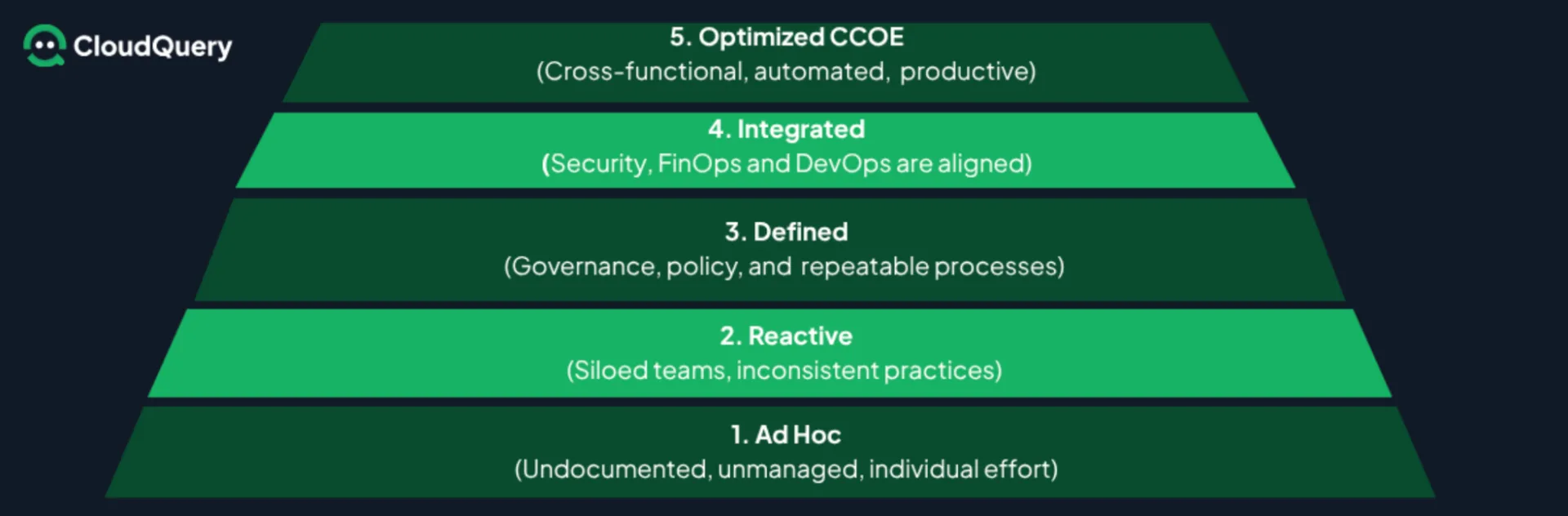
Figure 6. The Cloud Center of Excellence (CCOE) Maturity Pyramid. This model outlines the five stages organizations typically progress through, starting from ad-hoc, fragmented practices to a fully optimized, cross-functional governance model.
Pitfall 6: Metrics Not Defined or Tracked
Without metrics, a CoE may drift or fail to prove its value. It might also be unaware of problems (like increasing support burden) until too late.
Strategy: As discussed, define KPIs for the CoE. Additionally, set up a dashboard or reports on those KPIs that the CoE team reviews regularly. If something goes off track (say, cloud spend keeps overshooting budgets or a spike in security alerts), the CoE can react promptly, maybe by initiating a special cost optimization project or a security training push. Also share metrics with leadership to maintain support; for instance, if the CoE saved $X million or shortened deployment time by Y%, make sure executives know that.
Pitfall 7: Neglecting Disaster Recovery and Continuity
In focusing on building out new cloud capabilities, sometimes CoEs forget to plan for worst-case scenarios (cloud outages, etc.). This is risky for business continuity.
Strategy: Ensure the CoE also covers cloud resilience. Define disaster recovery (DR) plans for critical systems in the cloud, possibly as part of the architecture standards. Run game days or simulations to test how well teams can recover from cloud incidents. The CoE might coordinate these drills. Showing that cloud can be resilient (or identifying gaps if not) is key for full trust, especially from risk managers.
For organizations looking to replicate successful CCOEs (like those in our case studies), consider the following replication strategies:
-
Learn from Peers: Engage in industry user groups or cloud provider customer forums. Many companies share lessons (anonymized) in forums like the AWS Enterprise Community or at conferences. Some might even do reference calls if arranged through cloud vendors. Hearing how Company X structured their CoE or overcame a certain challenge can shortcut your learning.
-
Start Small, Scale Fast: It’s fine to begin with a small pilot CoE (even one person can start by drafting a plan), but have a plan to scale up once initial success is shown. Many firms begin with a Cloud “Tiger Team” then formalize into a CoE.
-
Adapt to Your Culture: Not every tactic works universally. For instance, Capital One’s heavy emphasis on certification might not fit a company that doesn’t value formal certs as much. Or a decentralized company might opt for a looser federation of CoE. Be ready to adapt practices to fit the organizational culture and structure (centralized company vs holding company vs highly agile tech firm, different approaches).
-
Use Cloud Providers and Consultants: AWS, Azure, and GCP all offer guidance on CoEs and have professional services to assist. While primary sources and internal effort are best for ownership, don’t shy from using experts to jump-start, e.g., AWS’s Prescriptive Guidance on CCOEs can serve as a checklist, and cloud consultants can share templates for policies, etc. Just avoid outsourcing the core decisions; use them as advisors so your team learns in the process.
-
Ensure Management Endorsement at All Levels: Senior exec sponsorship is key, but mid-level management buy-in is also needed (these are directors who control teams that must work with CoE). Conduct roadshows or one-on-one meetings with these managers to align expectations and address concerns. Replication of success in another org often fails if middle management resists (the “frozen middle”). Get them on board early.
Pitfall 8: Ignoring Exit Strategy or Evolution
One seldom-discussed aspect is knowing when the CoE’s job is done or needs to transform. In replication, one should ask: what’s the end state we aim for? If it’s perpetual improvement, fine, but some companies treat CoE as a temporary change vehicle.
Strategy: Decide if your CoE will eventually fold into normal IT operations or remain an ongoing center. Plan for that evolution. For example, after 5 years, maybe cloud is the norm and the CoE shifts focus to governing multi-cloud or new tech, or it might downsize and hand responsibilities to product teams. Having this vision can ensure the CoE is always providing value and not just persisting for its own sake.
By anticipating these pitfalls and proactively addressing them, organizations can greatly smooth the path of their Cloud CoE. The overarching strategy is to remain agile and responsive, a CoE should practice what it preaches by iterating and improving its own processes, much like DevOps teams do for software. The most successful CoEs effectively become internal consultants and service providers that others willingly approach, rather than police men that others evade. Replicating that model requires a keen focus on organizational change management in addition to technical prowess.
Key Takeaways
The difference between successful and failed CCOEs isn’t usually about the technical architecture or the governance frameworks - it’s about execution discipline and organizational change management. The most common failure mode isn’t picking the wrong cloud provider or missing a security control; it’s trying to do too much too fast, operating in a silo, or becoming a bottleneck instead of an enabler.
Critical success factors we’ve identified:
- Executive sponsorship that goes beyond initial approval to ongoing advocacy and resource allocation
- A cross-functional team composition that brings together technical and business perspectives
- Enablement-first mindset that focuses on empowering teams rather than controlling them
- Iterative implementation that delivers value quickly while building toward the long-term vision
- Full visibility into your actual cloud environment before trying to govern it
- Metrics-driven continuous improvement that keeps the CCOE aligned with business value
The organizations that follow these principles systematically report measurable outcomes: faster deployment times, reduced security incidents, significant cost savings, and improved developer satisfaction. Those who skip steps or treat the CCOE as a checkbox exercise often see their initiatives stall or get disbanded.
Coming Up
In the final part of this series, we’ll explore the future of CCOEs and provide you with a getting-started checklist. We’ll examine emerging trends like AI governance, sustainability tracking, and the evolution toward “Platform Engineering” models. We’ll also provide the tactical next steps to begin your CCOE journey, whether you’re starting from scratch or enhancing an existing program.

Joe Karlsson
Developer Marketing Engineer at CData, leading developer growth for the managed MCP platform that connects AI agents to live enterprise data. Writing about databases, self-hosting, and the things I build. Runs a 60+ container Proxmox homelab with AI-powered automations.
cat newsletter.md
I write a weekly newsletter about databases, self-hosting, and whatever I'm building.
Subscribe on Substack →Related Posts
Jun 3, 2025
Cloud Centers of Excellence (Part 1): Building Effective Cloud Governance Through Strategic Organization
Discover how to build a successful Cloud Center of Excellence (CCOE) to drive cloud governance, security, and innovation across your enterprise. Learn key structures, roles, and strategies in Part 1 of our 5-part implementation series.
Jun 3, 2025
Cloud Centers of Excellence (Part 2): Governance, Security, and Compliance in CCOEs
Who actually owns cloud policy? We break down how real CCOEs manage governance, enforce security without compromising velocity, and keep regulators at bay. We share what works and what quietly fails, inside enterprises handling sensitive workloads.
Jun 3, 2025
Cloud Centers of Excellence (Part 3): FinOps, Cost Management, and Real-World Case Studies
Cloud costs aren't just a budgeting issue, they're a systems problem. In Part 3, we unpack how mature CCOEs adopt FinOps practices to track every dollar, cut waste by up to 40%, and drive shared accountability across teams. Real examples from banks and enterprises show how this actually plays out.