TL;DR
I spent years producing content without knowing if any of it converted to actual business results. Getting read access to the CRM data - an afternoon of work I kept assuming would take weeks - changed how I understood my own impact.
For most of my last job, I couldn’t answer the most obvious question about my work.
Did anyone who read my content actually become a customer?
I had metrics. Good ones. Traffic was up. Search impressions were climbing. The content calendar was full. But every time someone asked the follow-up question - “did that drive any leads?” - I’d say some version of I don’t know, that lives in a system I don’t have access to. And after a while, I stopped asking. You internalize the limits of your tools.
The CRM lived with the sales team. I assumed getting access would mean a ticket, a queue, an engineer, a pipeline, weeks of waiting. So I never asked.
The assumption that was costing me
When I joined CData and started actually poking around how the company’s connectivity layer worked, something clicked. The data I needed wasn’t locked behind a months-long project. It was behind a permission change. An afternoon of work.
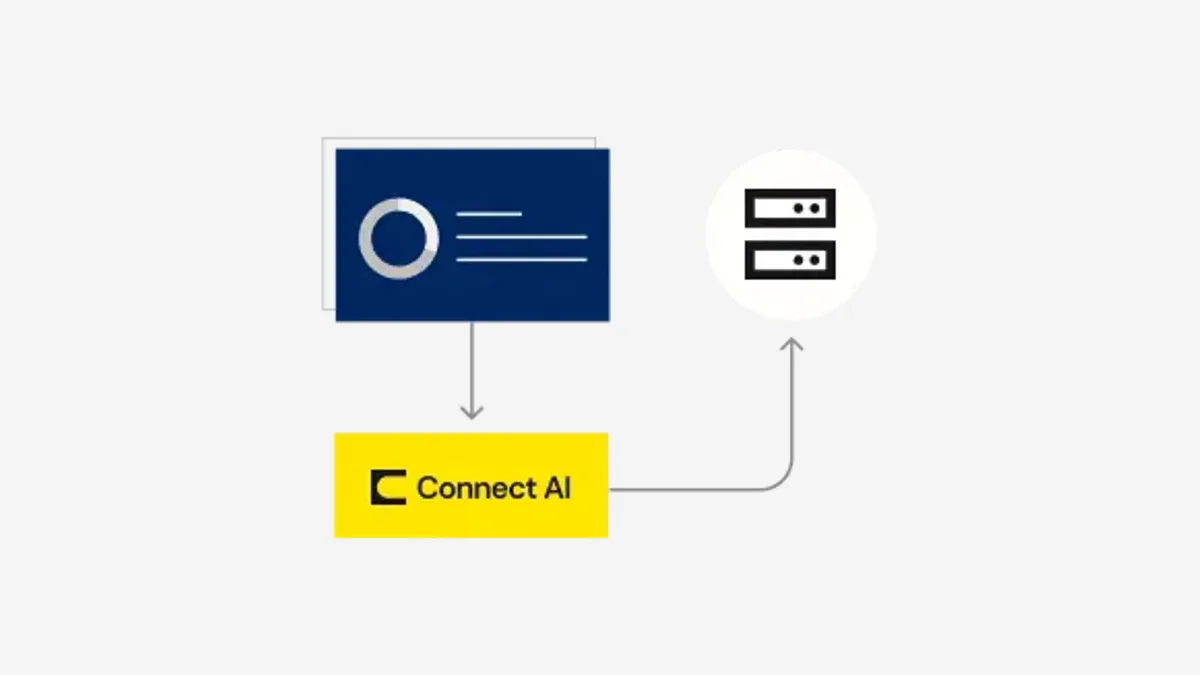
I used CData Connect AI to request CRM access and started designing a report that connected my content output to downstream conversions. The approach was embarrassingly simple once I stopped assuming it was hard.
I described what I wanted in plain language. An AI agent handled the query construction, the interface selection, the system addressing. When results looked wrong, I asked clarifying questions and we worked through it. I didn’t write SQL. I defined what mattered.
What four weeks of data showed
The first month of actually measuring impact was disorienting.
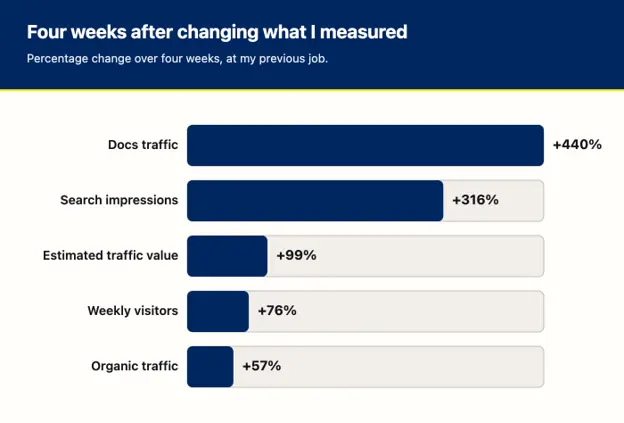
Docs traffic was up 440% over four weeks. Search impressions up 316%. One week hit 4.9x my previous all-time record for impressions. I wrote up how I diagnosed the decline and set up the weekly audit behind those numbers separately.
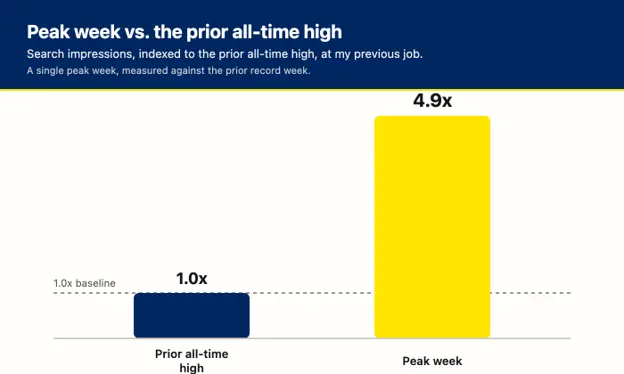
The reporting didn’t cause this. What it did was show me what was working so I could do more of it. The data changed where I aimed effort. That changed the results.
What visibility does to your influence
Here’s the part nobody talks about: once you can show downstream impact, the conversation with leadership changes completely.
Before, my 1:1s were about activity. What did I publish? What’s in the pipeline? After, we talked about strategy. Which content types are converting? What should we prioritize next quarter? My influence over what we actually worked on grew faster in that stretch than at any other point in my career.
That’s not a coincidence. When you’re a cost center with no legible connection to revenue, your opinion on priorities is polite input. When you can show a line between your work and business results, you’re a strategic decision-maker.
The integrity problem to watch out for
I want to be honest about something: this kind of self-reported measurement has real failure modes.
I’ve built scorecards and then started working for the scorecard. When you control how your own impact gets measured, there’s constant pressure to define “success” in ways that make your numbers look good. It’s subtle. You don’t notice yourself doing it.
What’s helped me stay honest:
- Document what I’m excluding from the analysis before I look at the results
- When my numbers disagree with official company metrics, treat mine as wrong
- Notice when my definitions of what “counts” are getting suspiciously convenient
The technical skill here is easy. Deciding what to measure and noticing when your own incentives are distorting the definition - that part’s human and hard.
The actual advice
If you’re a developer marketer, DevRel person, or content creator who can’t answer whether your work drives business results, this is what I’d suggest:
- Figure out the one question you can’t currently answer about downstream impact
- Find out which team owns that data
- Request read access by naming the specific question, not by asking for the whole dataset
- Ask whether your company already has a connectivity layer that might make this trivial
- Use an AI agent to build the report if you don’t want to learn the query language
The decision about what to measure - and the integrity to notice when your measurements are flattering you - stays yours. But the technical barrier to getting the data is lower than you think. Once you have it, these are the leading indicators I track for a DevRel program. Measurement is also what turns shipping a lot into getting better, which is the feedback loop I wrote about in Ship the Ugly Pot.
I spent two years not asking. Don’t do that.

Joe Karlsson
Developer Marketing Engineer at CData, leading developer growth for the managed MCP platform that connects AI agents to live enterprise data. Writing about databases, self-hosting, and the things I build. Runs a 60+ container Proxmox homelab with AI-powered automations.
cat newsletter.md
Works on My Machine is my newsletter: thoughts and reactions on tech writing, AI, homelab builds and open source, plus whatever I'm working on. It goes out when I have something to say.
Free, no spam, unsubscribe anytime. Read past issues.
Related Posts

Apr 21, 2026
Running DevRel in 2026 Means Owning Three Discovery Surfaces
Running DevRel in 2026: developers find you through people, search, and LLMs. What breaks on each surface, how I measure it, and my first 90 days.

Apr 7, 2026
Reversing SEO Traffic Decline From AI Overviews: A Weekly Audit (2026)
How I reversed an SEO traffic decline caused partly by AI Overviews: two failure modes, a weekly Claude Code audit, and real numbers from four weeks.

Aug 31, 2026
The Cognitive Case for Play in Technical Work
What research on creativity, flow states, and psychological safety says about the conditions that make your best iterative work possible - and how to build them.